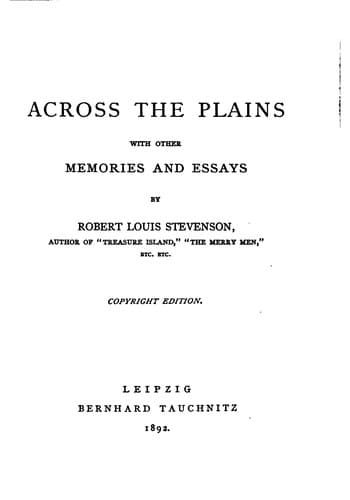
Across the Plains, with Other Memories and EssaysStevenson, Robert Louis
General
Across the Plains, with Other Memories and Essays
Stevenson, Robert Louis
Essays; Monterey (Calif.) -- Description and travel; West (U.S.) -- Description and travel
sand-wreaths. He had no thought but to spring up and rescue her; and
there they stood face to face, she with that deadly matter openly in her
hand—his very presence on the spot another link of proof. It was plain
she was about to speak, but this was more than he could bear—he could
bear to be lost, but not to talk of it with his destroyer; and he cut her
short with trivial conversation. Arm in arm, they returned together to
the train, talking he knew not what, made the journey back in the same
carriage, sat down to dinner, and passed the evening in the drawing-room
as in the past. But suspense and fear drummed in the dreamer’s bosom.
“She has not denounced me yet”—so his thoughts ran—“when will she
denounce me? Will it be to-morrow?” And it was not to-morrow, nor the
next day, nor the next; and their life settled back on the old terms,
only that she seemed kinder than before, and that, as for him, the
burthen of his suspense and wonder grew daily more unbearable, so that he
wasted away like a man with a disease. Once, indeed, he broke all bounds
of decency, seized an occasion when she was abroad, ransacked her room,
and at last, hidden away among her jewels, found the damning evidence.
There he stood, holding this thing, which was his life, in the hollow of
his hand, and marvelling at her inconsequent behaviour, that she should
seek, and keep, and yet not use it; and then the door opened, and behold
herself. So, once more, they stood, eye to eye, with the evidence
between them; and once more she raised to him a face brimming with some
communication; and once more he shied away from speech and cut her off.
But before he left the room, which he had turned upside down, he laid
back his death-warrant where he had found it; and at that, her face
lighted up. The next thing he heard, she was explaining to her maid,
with some ingenious falsehood, the disorder of her things. Flesh and
blood could bear the strain no longer; and I think it was the next
morning (though chronology is always hazy in the theatre of the mind)
that he burst from his reserve. They had been breakfasting together in
one corner of a great, parqueted, sparely-furnished room of many windows;
all the time of the meal she had tortured him with sly allusions; and no
sooner were the servants gone, and these two protagonists alone together,
than he leaped to his feet. She too sprang up, with a pale face; with a
pale face, she heard him as he raved out his complaint: Why did she
torture him so? she knew all, she knew he was no enemy to her; why did
she not denounce him at once? what signified her whole behaviour? why did
she torture him? and yet again, why did she torture him? And when he had
done, she fell upon her knees, and with outstretched hands: “Do you not
understand?” she cried. “I love you!”
Public-domain text, read in full here on John Shaqi.
Reviews
Reviews
No reviews yet
Be the first to share your thoughts on this work.
Elsewhere in the archive
Join the Discussion
Join the discussion
Sign in to leave a comment or review.
Sign InorCreate an account