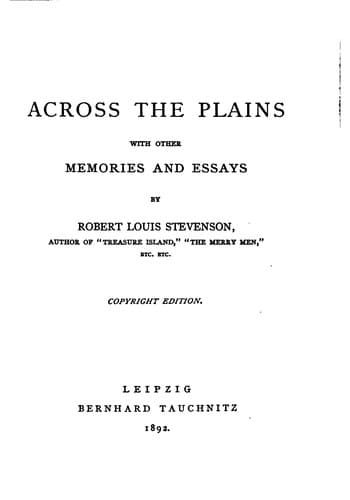
Across the Plains, with Other Memories and EssaysStevenson, Robert Louis
General
Across the Plains, with Other Memories and Essays
Stevenson, Robert Louis
Essays; Monterey (Calif.) -- Description and travel; West (U.S.) -- Description and travel
I can but give an instance or so of what part is done sleeping and what
part awake, and leave the reader to share what laurels there are, at his
own nod, between myself and my collaborators; and to do this I will first
take a book that a number of persons have been polite enough to read, the
_Strange Case of Dr. Jekyll and Mr. Hyde_. I had long been trying to
write a story on this subject, to find a body, a vehicle, for that strong
sense of man’s double being which must at times come in upon and
overwhelm the mind of every thinking creature. I had even written one,
_The Travelling Companion_, which was returned by an editor on the plea
that it was a work of genius and indecent, and which I burned the other
day on the ground that it was not a work of genius, and that _Jekyll_ had
supplanted it. Then came one of those financial fluctuations to which
(with an elegant modesty) I have hitherto referred in the third person.
For two days I went about racking my brains for a plot of any sort; and
on the second night I dreamed the scene at the window, and a scene
afterward split in two, in which Hyde, pursued for some crime, took the
powder and underwent the change in the presence of his pursuers. All the
rest was made awake, and consciously, although I think I can trace in
much of it the manner of my Brownies. The meaning of the tale is
therefore mine, and had long pre-existed in my garden of Adonis, and
tried one body after another in vain; indeed, I do most of the morality,
worse luck! and my Brownies have not a rudiment of what we call a
conscience. Mine, too, is the setting, mine the characters. All that
was given me was the matter of three scenes, and the central idea of a
voluntary change becoming involuntary. Will it be thought ungenerous,
after I have been so liberally ladling out praise to my unseen
collaborators, if I here toss them over, bound hand and foot, into the
arena of the critics? For the business of the powders, which so many
have censured, is, I am relieved to say, not mine at all but the
Brownies’. Of another tale, in case the reader should have glanced at
it, I may say a word: the not very defensible story of _Olalla_. Here
the court, the mother, the mother’s niche, Olalla, Olalla’s chamber, the
meetings on the stair, the broken window, the ugly scene of the bite,
were all given me in bulk and detail as I have tried to write them; to
this I added only the external scenery (for in my dream I never was
beyond the court), the portrait, the characters of Felipe and the priest,
the moral, such as it is, and the last pages, such as, alas! they are.
And I may even say that in this case the moral itself was given me; for
it arose immediately on a comparison of the mother and the daughter, and
from the hideous trick of atavism in the first. Sometimes a parabolic
sense is still more undeniably present in a dream; sometimes I cannot but
suppose my Brownies have been aping Bunyan, and yet in no case with what
Public-domain text, read in full here on John Shaqi.
Reviews
Reviews
No reviews yet
Be the first to share your thoughts on this work.
Elsewhere in the archive
Join the Discussion
Join the discussion
Sign in to leave a comment or review.
Sign InorCreate an account