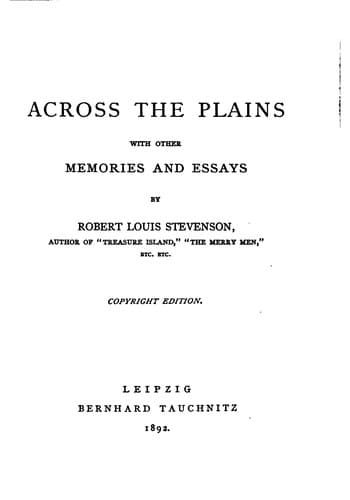
Across the Plains, with Other Memories and EssaysStevenson, Robert Louis
General
Across the Plains, with Other Memories and Essays
Stevenson, Robert Louis
Essays; Monterey (Calif.) -- Description and travel; West (U.S.) -- Description and travel
would possibly be called a moral in a tract; never with the ethical
narrowness; conveying hints instead of life’s larger limitations and that
sort of sense which we seem to perceive in the arabesque of time and
space.
For the most part, it will be seen, my Brownies are somewhat fantastic,
like their stories hot and hot, full of passion and the picturesque,
alive with animating incident; and they have no prejudice against the
supernatural. But the other day they gave me a surprise, entertaining me
with a love-story, a little April comedy, which I ought certainly to hand
over to the author of _A Chance Acquaintance_, for he could write it as
it should be written, and I am sure (although I mean to try) that I
cannot.—But who would have supposed that a Brownie of mine should invent
a tale for Mr. Howells?
IX
BEGGARS
I.
IN a pleasant, airy, up-hill country, it was my fortune when I was young
to make the acquaintance of a certain beggar. I call him beggar, though
he usually allowed his coat and his shoes (which were open-mouthed,
indeed) to beg for him. He was the wreck of an athletic man, tall,
gaunt, and bronzed; far gone in consumption, with that disquieting smile
of the mortally stricken on his face; but still active afoot, still with
the brisk military carriage, the ready military salute. Three ways led
through this piece of country; and as I was inconstant in my choice, I
believe he must often have awaited me in vain. But often enough, he
caught me; often enough, from some place of ambush by the roadside, he
would spring suddenly forth in the regulation attitude, and launching at
once into his inconsequential talk, fall into step with me upon my
farther course. “A fine morning, sir, though perhaps a trifle inclining
to rain. I hope I see you well, sir. Why, no, sir, I don’t feel as
hearty myself as I could wish, but I am keeping about my ordinary. I am
pleased to meet you on the road, sir. I assure you I quite look forward
to one of our little conversations.” He loved the sound of his own voice
inordinately, and though (with something too off-hand to call servility)
he would always hasten to agree with anything you said, yet he could
never suffer you to say it to an end. By what transition he slid to his
favourite subject I have no memory; but we had never been long together
on the way before he was dealing, in a very military manner, with the
English poets. “Shelley was a fine poet, sir, though a trifle
atheistical in his opinions. His Queen Mab, sir, is quite an atheistical
work. Scott, sir, is not so poetical a writer. With the works of
Shakespeare I am not so well acquainted, but he was a fine poet.
Keats—John Keats, sir—he was a very fine poet.” With such references,
such trivial criticism, such loving parade of his own knowledge, he would
beguile the road, striding forward uphill, his staff now clapped to the
ribs of his deep, resonant chest, now swinging in the air with the
Public-domain text, read in full here on John Shaqi.
Reviews
Reviews
No reviews yet
Be the first to share your thoughts on this work.
Elsewhere in the archive
Join the Discussion
Join the discussion
Sign in to leave a comment or review.
Sign InorCreate an account