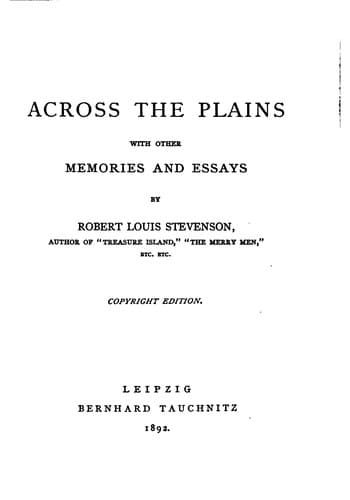
Across the Plains, with Other Memories and EssaysStevenson, Robert Louis
General
Across the Plains, with Other Memories and Essays
Stevenson, Robert Louis
Essays; Monterey (Calif.) -- Description and travel; West (U.S.) -- Description and travel
Keats—John Keats, sir—and Shelley were his favourite bards. I cannot
remember if I tried him with Rossetti; but I know his taste to a hair,
and if ever I did, he must have doted on that author. What took him was
a richness in the speech; he loved the exotic, the unexpected word; the
moving cadence of a phrase; a vague sense of emotion (about nothing) in
the very letters of the alphabet: the romance of language. His honest
head was very nearly empty, his intellect like a child’s; and when he
read his favourite authors, he can almost never have understood what he
was reading. Yet the taste was not only genuine, it was exclusive; I
tried in vain to offer him novels; he would none of them, he cared for
nothing but romantic language that he could not understand. The case may
be commoner than we suppose. I am reminded of a lad who was laid in the
next cot to a friend of mine in a public hospital and who was no sooner
installed than he sent out (perhaps with his last pence) for a cheap
Shakespeare. My friend pricked up his ears; fell at once in talk with
his new neighbour, and was ready, when the book arrived, to make a
singular discovery. For this lover of great literature understood not
one sentence out of twelve, and his favourite part was that of which he
understood the least—the inimitable, mouth-filling rodomontade of the
ghost in _Hamlet_. It was a bright day in hospital when my friend
expounded the sense of this beloved jargon: a task for which I am willing
to believe my friend was very fit, though I can never regard it as an
easy one. I know indeed a point or two, on which I would gladly question
Mr. Shakespeare, that lover of big words, could he revisit the glimpses
of the moon, or could I myself climb backward to the spacious days of
Elizabeth. But in the second case, I should most likely pretermit these
questionings, and take my place instead in the pit at the Blackfriars, to
hear the actor in his favourite part, playing up to Mr. Burbage, and
rolling out—as I seem to hear him—with a ponderous gusto—
“Unhousel’d, disappointed, unanel’d.”
What a pleasant chance, if we could go there in a party I and what a
surprise for Mr. Burbage, when the ghost received the honours of the
evening!
As for my old soldier, like Mr. Burbage and Mr. Shakespeare, he is long
since dead; and now lies buried, I suppose, and nameless and quite
forgotten, in some poor city graveyard.—But not for me, you brave heart,
have you been buried! For me, you are still afoot, tasting the sun and
air, and striding southward. By the groves of Comiston and beside the
Hermitage of Braid, by the Hunters’ Tryst, and where the curlews and
plovers cry around Fairmilehead, I see and hear you, stalwartly carrying
your deadly sickness, cheerfully discoursing of uncomprehended poets.
II
Public-domain text, read in full here on John Shaqi.
Reviews
Reviews
No reviews yet
Be the first to share your thoughts on this work.
Elsewhere in the archive
Join the Discussion
Join the discussion
Sign in to leave a comment or review.
Sign InorCreate an account