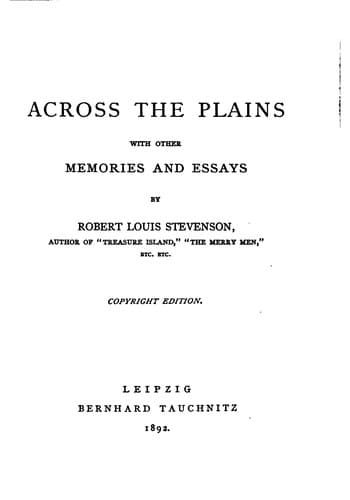
Across the Plains, with Other Memories and EssaysStevenson, Robert Louis
General
Across the Plains, with Other Memories and Essays
Stevenson, Robert Louis
Essays; Monterey (Calif.) -- Description and travel; West (U.S.) -- Description and travel
The thought of the old soldier recalls that of another tramp, his
counterpart. This was a little, lean, and fiery man, with the eyes of a
dog and the face of a gipsy; whom I found one morning encamped with his
wife and children and his grinder’s wheel, beside the burn of Kinnaird.
To this beloved dell I went, at that time, daily; and daily the
knife-grinder and I (for as long as his tent continued pleasantly to
interrupt my little wilderness) sat on two stones, and smoked, and
plucked grass, and talked to the tune of the brown water. His children
were mere whelps, they fought and bit among the fern like vermin. His
wife was a mere squaw; I saw her gather brush and tend the kettle, but
she never ventured to address her lord while I was present. The tent was
a mere gipsy hovel, like a sty for pigs. But the grinder himself had the
fine self-sufficiency and grave politeness of the hunter and the savage;
he did me the honours of this dell, which had been mine but the day
before, took me far into the secrets of his life, and used me (I am proud
to remember) as a friend.
Like my old soldier, he was far gone in the national complaint. Unlike
him, he had a vulgar taste in letters; scarce flying higher than the
story papers; probably finding no difference, certainly seeking none,
between Tannahill and Burns; his noblest thoughts, whether of poetry or
music, adequately embodied in that somewhat obvious ditty,
“Will ye gang, lassie, gang
To the braes o’ Balquidder.”
—which is indeed apt to echo in the ears of Scottish children, and to
him, in view of his experience, must have found a special directness of
address. But if he had no fine sense of poetry in letters, he felt with
a deep joy the poetry of life. You should have heard him speak of what
he loved; of the tent pitched beside the talking water; of the stars
overhead at night; of the blest return of morning, the peep of day over
the moors, the awaking birds among the birches; how he abhorred the long
winter shut in cities; and with what delight, at the return of the
spring, he once more pitched his camp in the living out-of-doors. But we
were a pair of tramps; and to you, who are doubtless sedentary and a
consistent first-class passenger in life, he would scarce have laid
himself so open;—to you, he might have been content to tell his story of
a ghost—that of a buccaneer with his pistols as he lived—whom he had once
encountered in a seaside cave near Buckie; and that would have been
enough, for that would have shown you the mettle of the man. Here was a
piece of experience solidly and livingly built up in words, here was a
story created, _teres atque rotundus_.
Public-domain text, read in full here on John Shaqi.
Reviews
Reviews
No reviews yet
Be the first to share your thoughts on this work.
Elsewhere in the archive
Join the Discussion
Join the discussion
Sign in to leave a comment or review.
Sign InorCreate an account