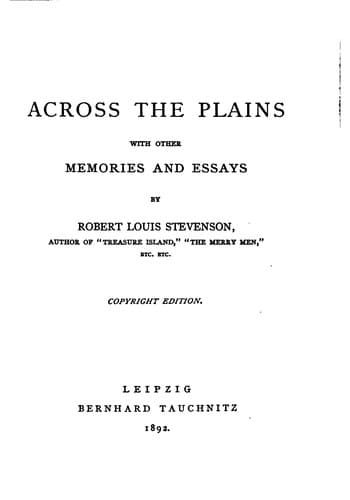
Across the Plains, with Other Memories and EssaysStevenson, Robert Louis
General
Across the Plains, with Other Memories and Essays
Stevenson, Robert Louis
Essays; Monterey (Calif.) -- Description and travel; West (U.S.) -- Description and travel
This, which is not so much a vocation for art as an impatience of all
other honest trades, frequently exists alone; and so existing, it will
pass gently away in the course of years. Emphatically, it is not to be
regarded; it is not a vocation, but a temptation; and when your father
the other day so fiercely and (in my view) so properly discouraged your
ambition, he was recalling not improbably some similar passage in his own
experience. For the temptation is perhaps nearly as common as the
vocation is rare. But again we have vocations which are imperfect; we
have men whose minds are bound up, not so much in any art, as in the
general _ars artium_ and common base of all creative work; who will now
dip into painting, and now study counterpoint, and anon will be inditing
a sonnet: all these with equal interest, all often with genuine
knowledge. And of this temper, when it stands alone, I find it difficult
to speak; but I should counsel such an one to take to letters, for in
literature (which drags with so wide a net) all his information may be
found some day useful, and if he should go on as he has begun, and turn
at last into the critic, he will have learned to use the necessary tools.
Lastly we come to those vocations which are at once decisive and precise;
to the men who are born with the love of pigments, the passion of
drawing, the gift of music, or the impulse to create with words, just as
other and perhaps the same men are born with the love of hunting, or the
sea, or horses, or the turning-lathe. These are predestined; if a man
love the labour of any trade, apart from any question of success or fame,
the gods have called him. He may have the general vocation too: he may
have a taste for all the arts, and I think he often has; but the mark of
his calling is this laborious partiality for one, this inextinguishable
zest in its technical successes, and (perhaps above all) a certain
candour of mind to take his very trifling enterprise with a gravity that
would befit the cares of empire, and to think the smallest improvement
worth accomplishing at any expense of time and industry. The book, the
statue, the sonata, must be gone upon with the unreasoning good faith and
the unflagging spirit of children at their play. _Is it worth
doing_?—when it shall have occurred to any artist to ask himself that
question, it is implicitly answered in the negative. It does not occur
to the child as he plays at being a pirate on the dining-room sofa, nor
to the hunter as he pursues his quarry; and the candour of the one and
the ardour of the other should be united in the bosom of the artist.
Public-domain text, read in full here on John Shaqi.
Reviews
Reviews
No reviews yet
Be the first to share your thoughts on this work.
Elsewhere in the archive
Join the Discussion
Join the discussion
Sign in to leave a comment or review.
Sign InorCreate an account