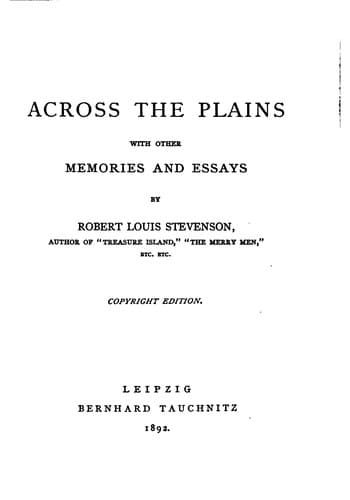
Across the Plains, with Other Memories and EssaysStevenson, Robert Louis
General
Across the Plains, with Other Memories and Essays
Stevenson, Robert Louis
Essays; Monterey (Calif.) -- Description and travel; West (U.S.) -- Description and travel
Nor will the practice of art afford you pleasure only; it affords besides
an admirable training. For the artist works entirely upon honour. The
public knows little or nothing of those merits in the quest of which you
are condemned to spend the bulk of your endeavours. Merits of design,
the merit of first-hand energy, the merit of a certain cheap
accomplishment which a man of the artistic temper easily acquires—these
they can recognise, and these they value. But to those more exquisite
refinements of proficiency and finish, which the artist so ardently
desires and so keenly feels, for which (in the vigorous words of Balzac)
he must toil “like a miner buried in a landslip,” for which, day after
day, he recasts and revises and rejects—the gross mass of the public must
be ever blind. To those lost pains, suppose you attain the highest pitch
of merit, posterity may possibly do justice; suppose, as is so probable,
you fall by even a hair’s breadth of the highest, rest certain they shall
never be observed. Under the shadow of this cold thought, alone in his
studio, the artist must preserve from day to day his constancy to the
ideal. It is this which makes his life noble; it is by this that the
practice of his craft strengthens and matures his character; it is for
this that even the serious countenance of the great emperor was turned
approvingly (if only for a moment) on the followers of Apollo, and that
sternly gentle voice bade the artist cherish his art.
And here there fall two warnings to be made. First, if you are to
continue to be a law to yourself, you must beware of the first signs of
laziness. This idealism in honesty can only be supported by perpetual
effort; the standard is easily lowered, the artist who says “_It will
do_,” is on the downward path; three or four pot-boilers are enough at
times (above all at wrong times) to falsify a talent, and by the practice
of journalism a man runs the risk of becoming wedded to cheap finish.
This is the danger on the one side; there is not less upon the other.
The consciousness of how much the artist is (and must be) a law to
himself, debauches the small heads. Perceiving recondite merits very
hard to attain, making or swallowing artistic formulæ, or perhaps falling
in love with some particular proficiency of his own, many artists forget
the end of all art: to please. It is doubtless tempting to exclaim
against the ignorant bourgeois; yet it should not be forgotten, it is he
who is to pay us, and that (surely on the face of it) for services that
he shall desire to have performed. Here also, if properly considered,
there is a question of transcendental honesty. To give the public what
they do not want, and yet expect to be supported: we have there a strange
pretension, and yet not uncommon, above all with painters. The first
duty in this world is for a man to pay his way; when that is quite
accomplished, he may plunge into what eccentricity he likes; but
emphatically not till then.
Public-domain text, read in full here on John Shaqi.
Reviews
Reviews
No reviews yet
Be the first to share your thoughts on this work.
Elsewhere in the archive
Join the Discussion
Join the discussion
Sign in to leave a comment or review.
Sign InorCreate an account