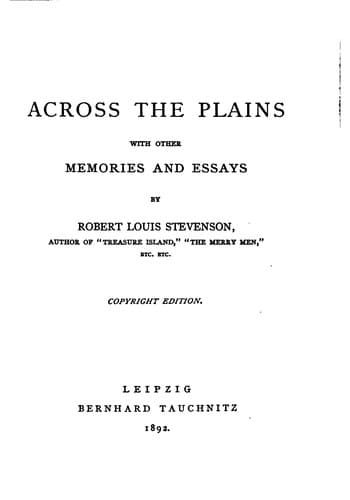
Across the Plains, with Other Memories and EssaysStevenson, Robert Louis
General
Across the Plains, with Other Memories and Essays
Stevenson, Robert Louis
Essays; Monterey (Calif.) -- Description and travel; West (U.S.) -- Description and travel
But the devil in these trades of pleasing is to fail to please. In
ordinary occupations, a man offers to do a certain thing or to produce a
certain article with a merely conventional accomplishment, a design in
which (we may almost say) it is difficult to fail. But the artist steps
forth out of the crowd and proposes to delight: an impudent design, in
which it is impossible to fail without odious circumstances. The poor
Daughter of Joy, carrying her smiles and finery quite unregarded through
the crowd, makes a figure which it is impossible to recall without a
wounding pity. She is the type of the unsuccessful artist. The actor,
the dancer, and the singer must appear like her in person, and drain
publicly the cup of failure. But though the rest of us escape this
crowning bitterness of the pillory, we all court in essence the same
humiliation. We all profess to be able to delight. And how few of us
are! We all pledge ourselves to be able to continue to delight. And the
day will come to each, and even to the most admired, when the ardour
shall have declined and the cunning shall be lost, and he shall sit by
his deserted booth ashamed. Then shall he see himself condemned to do
work for which he blushes to take payment. Then (as if his lot were not
already cruel) he must lie exposed to the gibes of the wreckers of the
press, who earn a little bitter bread by the condemnation of trash which
they have not read, and the praise of excellence which they cannot
understand.
And observe that this seems almost the necessary end at least of writers.
_Les blancs et les Bleus_ (for instance) is of an order of merit very
different from _Le Vicomte de Braglonne_; and if any gentleman can bear
to spy upon the nakedness of _Castle Dangerous_, his name I think is Ham:
let it be enough for the rest of us to read of it (not without tears) in
the pages of Lockhart. Thus in old age, when occupation and comfort are
most needful, the writer must lay aside at once his pastime and his
breadwinner. The painter indeed, if he succeed at all in engaging the
attention of the public, gains great sums and can stand to his easel
until a great age without dishonourable failure. The writer has the
double misfortune to be ill-paid while he can work, and to be incapable
of working when he is old. It is thus a way of life which conducts
directly to a false position.
Public-domain text, read in full here on John Shaqi.
Reviews
Reviews
No reviews yet
Be the first to share your thoughts on this work.
Elsewhere in the archive
Join the Discussion
Join the discussion
Sign in to leave a comment or review.
Sign InorCreate an account