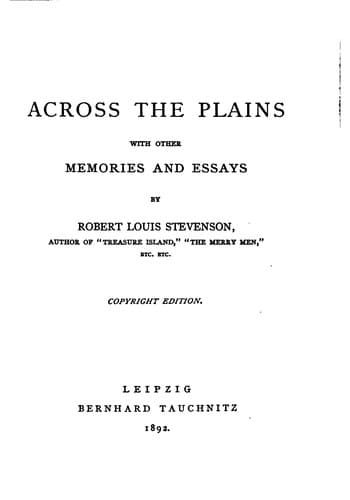
Across the Plains, with Other Memories and EssaysStevenson, Robert Louis
General
Across the Plains, with Other Memories and Essays
Stevenson, Robert Louis
Essays; Monterey (Calif.) -- Description and travel; West (U.S.) -- Description and travel
For the writer (in spite of notorious examples to the contrary) must look
to be ill-paid. Tennyson and Montépin make handsome livelihoods; but we
cannot all hope to be Tennyson, and we do not all perhaps desire to be
Montépin. If you adopt an art to be your trade, weed your mind at the
outset of all desire of money. What you may decently expect, if you have
some talent and much industry, is such an income as a clerk will earn
with a tenth or perhaps a twentieth of your nervous output. Nor have you
the right to look for more; in the wages of the life, not in the wages of
the trade, lies your reward; the work is here the wages. It will be seen
I have little sympathy with the common lamentations of the artist class.
Perhaps they do not remember the hire of the field labourer; or do they
think no parallel will lie? Perhaps they have never observed what is the
retiring allowance of a field officer; or do they suppose their
contributions to the arts of pleasing more important than the services of
a colonel? Perhaps they forget on how little Millet was content to live;
or do they think, because they have less genius, they stand excused from
the display of equal virtues? But upon one point there should be no
dubiety: if a man be not frugal, he has no business in the arts. If he
be not frugal, he steers directly for that last tragic scene of _le vieux
saltimbanque_; if he be not frugal, he will find it hard to continue to
be honest. Some day, when the butcher is knocking at the door, he may be
tempted, he may be obliged, to turn out and sell a slovenly piece of
work. If the obligation shall have arisen through no wantonness of his
own, he is even to be commanded; for words cannot describe how far more
necessary it is that a man should support his family, than that he should
attain to—or preserve—distinction in the arts. But if the pressure
comes, through his own fault, he has stolen, and stolen under trust, and
stolen (which is the worst of all) in such a way that no law can reach
him.
Public-domain text, read in full here on John Shaqi.
Reviews
Reviews
No reviews yet
Be the first to share your thoughts on this work.
Elsewhere in the archive
Join the Discussion
Join the discussion
Sign in to leave a comment or review.
Sign InorCreate an account