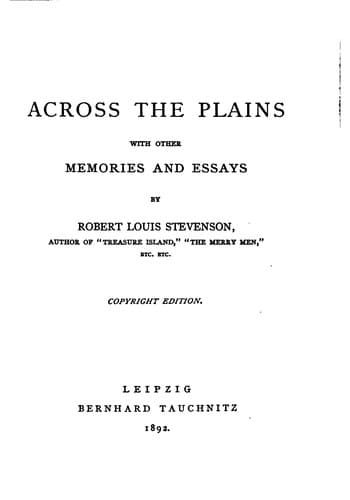
Across the Plains, with Other Memories and EssaysStevenson, Robert Louis
General
Across the Plains, with Other Memories and Essays
Stevenson, Robert Louis
Essays; Monterey (Calif.) -- Description and travel; West (U.S.) -- Description and travel
But Christmas is not only the mile-mark of another year, moving us to
thoughts of self-examination: it is a season, from all its associations,
whether domestic or religious, suggesting thoughts of joy. A man
dissatisfied with his endeavours is a man tempted to sadness. And in the
midst of the winter, when his life runs lowest and he is reminded of the
empty chairs of his beloved, it is well he should be condemned to this
fashion of the smiling face. Noble disappointment, noble self-denial,
are not to be admired, not even to be pardoned, if they bring bitterness.
It is one thing to enter the kingdom of heaven maim; another to maim
yourself and stay without. And the kingdom of heaven is of the
child-like, of those who are easy to please, who love and who give
pleasure. Mighty men of their hands, the smiters and the builders and
the judges, have lived long and done sternly and yet preserved this
lovely character; and among our carpet interests and twopenny concerns,
the shame were indelible if _we_ should lose it. Gentleness and
cheerfulness, these come before all morality; they are the perfect
duties. And it is the trouble with moral men that they have neither one
nor other. It was the moral man, the Pharisee, whom Christ could not
away with. If your morals make you dreary, depend upon it they are
wrong. I do not say “give them up,” for they may be all you have; but
conceal them like a vice, lest they should spoil the lives of better and
simpler people.
A strange temptation attends upon man: to keep his eye on pleasures, even
when he will not share in them; to aim all his morals against them. This
very year a lady (singular iconoclast!) proclaimed a crusade against
dolls; and the racy sermon against lust is a feature of the age. I
venture to call such moralists insincere. At any excess or perversion of
a natural appetite, their lyre sounds of itself with relishing
denunciations; but for all displays of the truly diabolic—envy, malice,
the mean lie, the mean silence, the calumnious truth, the back-biter, the
petty tyrant, the peevish poisoner of family life—their standard is quite
different. These are wrong, they will admit, yet somehow not so wrong;
there is no zeal in their assault on them, no secret element of gusto
warms up the sermon; it is for things not wrong in themselves that they
reserve the choicest of their indignation. A man may naturally disclaim
all moral kinship with the Reverend Mr. Zola or the hobgoblin old lady of
the dolls; for these are gross and naked instances. And yet in each of
us some similar element resides. The sight of a pleasure in which we
cannot or else will not share moves us to a particular impatience. It
may be because we are envious, or because we are sad, or because we
dislike noise and romping—being so refined, or because—being so
philosophic—we have an over-weighing sense of life’s gravity: at least,
as we go on in years, we are all tempted to frown upon our neighbour’s
pleasures.
Public-domain text, read in full here on John Shaqi.
Reviews
Reviews
No reviews yet
Be the first to share your thoughts on this work.
Elsewhere in the archive
Join the Discussion
Join the discussion
Sign in to leave a comment or review.
Sign InorCreate an account