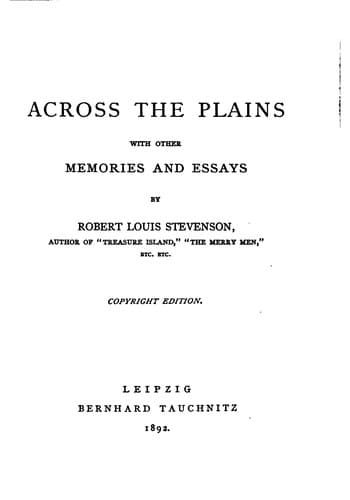
Across the Plains, with Other Memories and EssaysStevenson, Robert Louis
General
Across the Plains, with Other Memories and Essays
Stevenson, Robert Louis
Essays; Monterey (Calif.) -- Description and travel; West (U.S.) -- Description and travel
People are nowadays so fond of resisting temptations; here is
one to be resisted. They are fond of self-denial; here is a propensity
that cannot be too peremptorily denied. There is an idea abroad among
moral people that they should make their neighbours good. One person I
have to make good: myself. But my duty to my neighbour is much more
nearly expressed by saying that I have to make him happy—if I may.
III
Happiness and goodness, according to canting moralists, stand in the
relation of effect and cause. There was never anything less proved or
less probable: our happiness is never in our own hands; we inherit our
constitution; we stand buffet among friends and enemies; we may be so
built as to feel a sneer or an aspersion with unusual keenness, and so
circumstanced as to be unusually exposed to them; we may have nerves very
sensitive to pain, and be afflicted with a disease very painful. Virtue
will not help us, and it is not meant to help us. It is not even its own
reward, except for the self-centred and—I had almost said—the unamiable.
No man can pacify his conscience; if quiet be what he want, he shall do
better to let that organ perish from disuse. And to avoid the penalties
of the law, and the minor _capitis diminutio_ of social ostracism, is an
affair of wisdom—of cunning, if you will—and not of virtue.
In his own life, then, a man is not to expect happiness, only to profit
by it gladly when it shall arise; he is on duty here; he knows not how or
why, and does not need to know; he knows not for what hire, and must not
ask. Somehow or other, though he does not know what goodness is, he must
try to be good; somehow or other, though he cannot tell what will do it,
he must try to give happiness to others. And no doubt there comes in
here a frequent clash of duties. How far is he to make his neighbour
happy? How far must he respect that smiling face, so easy to cloud, so
hard to brighten again? And how far, on the other side, is he bound to
be his brother’s keeper and the prophet of his own morality? How far
must he resent evil?
Public-domain text, read in full here on John Shaqi.
Reviews
Reviews
No reviews yet
Be the first to share your thoughts on this work.
Elsewhere in the archive
Join the Discussion
Join the discussion
Sign in to leave a comment or review.
Sign InorCreate an account