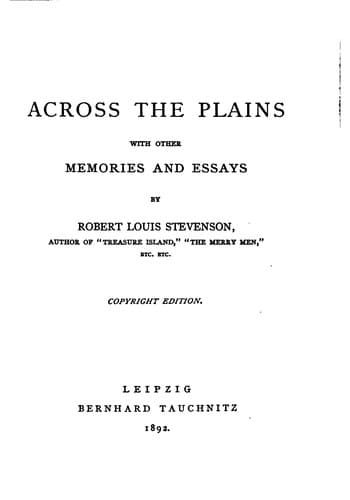
Across the Plains, with Other Memories and Essays — John Shaqi
Across the Plains, with Other Memories and EssaysStevenson, Robert Louis
General
Across the Plains, with Other Memories and Essays
Stevenson, Robert Louis
Essays; Monterey (Calif.) -- Description and travel; West (U.S.) -- Description and travel
There were meals to be had, however, by the wayside: a breakfast in the
morning, a dinner somewhere between eleven and two, and supper from five
to eight or nine at night. We had rarely less than twenty minutes for
each; and if we had not spent many another twenty minutes waiting for
some express upon a side track among miles of desert, we might have taken
an hour to each repast and arrived at San Francisco up to time. For
haste is not the foible of an emigrant train. It gets through on
sufferance, running the gauntlet among its more considerable brethren;
should there be a block, it is unhesitatingly sacrificed; and they
cannot, in consequence, predict the length of the passage within a day or
so. Civility is the main comfort that you miss. Equality, though
conceived very largely in America, does not extend so low down as to an
emigrant. Thus in all other trains, a warning cry of “All aboard!”
recalls the passengers to take their seats; but as soon as I was alone
with emigrants, and from the Transfer all the way to San Francisco, I
found this ceremony was pretermitted; the train stole from the station
without note of warning, and you had to keep an eye upon it even while
you ate. The annoyance is considerable, and the disrespect both wanton
and petty.
Many conductors, again, will hold no communication with an emigrant. I
asked a conductor one day at what time the train would stop for dinner;
as he made no answer I repeated the question, with a like result; a third
time I returned to the charge, and then Jack-in-office looked me coolly
in the face for several seconds and turned ostentatiously away. I
believe he was half ashamed of his brutality; for when another person
made the same inquiry, although he still refused the information, he
condescended to answer, and even to justify his reticence in a voice loud
enough for me to hear. It was, he said, his principle not to tell people
where they were to dine; for one answer led to many other questions, as
what o’clock it was? or, how soon should we be there? and he could not
afford to be eternally worried.
Public-domain text, read in full here on John Shaqi.
Reviews
Reviews
No reviews yet
Be the first to share your thoughts on this work.
Join the Discussion
Join the discussion
Sign in to leave a comment or review.
Sign InorCreate an account