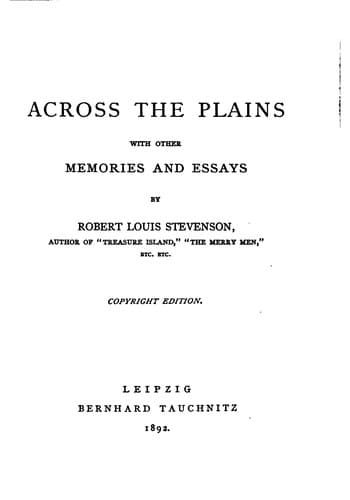
Across the Plains, with Other Memories and EssaysStevenson, Robert Louis
General
Across the Plains, with Other Memories and Essays
Stevenson, Robert Louis
Essays; Monterey (Calif.) -- Description and travel; West (U.S.) -- Description and travel
The above is a rough summary of this momentous conversation, in which I
have been chiefly careful to preserve the plums of the Commissary; but
the remainder of the scene, perhaps because of his rising anger, has left
but little definite in the memory of the Arethusa. The Commissary was
not, I think, a practised literary man; no sooner, at least, had he taken
pen in hand and embarked on the composition of the _procès-verbal_, than
he became distinctly more uncivil and began to show a predilection for
that simplest of all forms of repartee: “You lie!” Several times the
Arethusa let it pass, and then suddenly flared up, refused to accept more
insults or to answer further questions, defied the Commissary to do his
worst, and promised him, if he did, that he should bitterly repent it.
Perhaps if he had worn this proud front from the first, instead of
beginning with a sense of entertainment and then going on to argue, the
thing might have turned otherwise; for even at this eleventh hour the
Commissary was visibly staggered. But it was too late; he had been
challenged the _procès-verbal_ was begun; and he again squared his elbows
over his writing, and the Arethusa was led forth a prisoner.
A step or two down the hot road stood the gendarmerie. Thither was our
unfortunate conducted, and there he was bidden to empty forth the
contents of his pockets. A handkerchief, a pen, a pencil, a pipe and
tobacco, matches, and some ten francs of change: that was all. Not a
file, not a cipher, not a scrap of writing whether to identify or to
condemn. The very gendarme was appalled before such destitution.
“I regret,” he said, “that I arrested you, for I see that you are no
_voyou_.” And he promised him every indulgence.
The Arethusa, thus encouraged, asked for his pipe. That he was told was
impossible, but if he chewed, he might have some tobacco. He did not
chew, however, and asked instead to have his handkerchief.
“_Non_,” said the gendarme. “_Nous avons eu des histoires de gens qui se
sont pendus_.” (No, we have had histories of people who hanged
themselves.)
“What,” cried the Arethusa. “And is it for that you refuse me my
handkerchief? But see how much more easily I could hang myself in my
trousers!”
The man was struck by the novelty of the idea; but he stuck to his
colours, and only continued to repeat vague offers of service.
“At least,” said the Arethusa, “be sure that you arrest my comrade; he
will follow me ere long on the same road, and you can tell him by the
sack upon his shoulders.”
This promised, the prisoner was led round into the back court of the
building, a cellar door was opened, he was motioned down the stair, and
bolts grated and chains clanged behind his descending person.
Public-domain text, read in full here on John Shaqi.
Reviews
Reviews
No reviews yet
Be the first to share your thoughts on this work.
Elsewhere in the archive
Join the Discussion
Join the discussion
Sign in to leave a comment or review.
Sign InorCreate an account