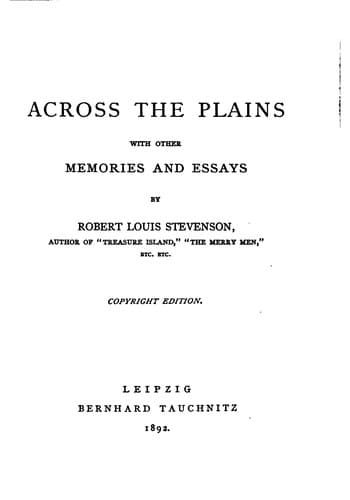
Across the Plains, with Other Memories and EssaysStevenson, Robert Louis
General
Across the Plains, with Other Memories and Essays
Stevenson, Robert Louis
Essays; Monterey (Calif.) -- Description and travel; West (U.S.) -- Description and travel
The culprit remaining silent under this home thrust, the Commissary
relished his triumph for a while, and then demanded (like the postman,
but with what different expectations!) to see the contents of the
knapsack. And here the Arethusa, not yet sufficiently awake to his
position, fell into a grave mistake. There was little or no furniture in
the room except the Commissary’s chair and table; and to facilitate
matters, the Arethusa (with all the innocence on earth) leant the
knapsack on a corner of the bed. The Commissary fairly bounded from his
seat; his face and neck flushed past purple, almost into blue; and he
screamed to lay the desecrating object on the floor.
The knapsack proved to contain a change of shirts, of shoes, of socks,
and of linen trousers, a small dressing-case, a piece of soap in one of
the shoes, two volumes of the _Collection Jannet_ lettered _Poésies de
Charles d’Orléans_, a map, and a version book containing divers notes in
prose and the remarkable English roundels of the voyager, still to this
day unpublished: the Commissary of Châtillon is the only living man who
has clapped an eye on these artistic trifles. He turned the assortment
over with a contumelious finger; it was plain from his daintiness that he
regarded the Arethusa and all his belongings as the very temple of
infection. Still there was nothing suspicious about the map, nothing
really criminal except the roundels; as for Charles of Orleans, to the
ignorant mind of the prisoner, he seemed as good as a certificate; and it
was supposed the farce was nearly over.
The inquisitor resumed his seat.
THE COMMISSARY (_after a pause_). _Eh bien_, _je vais vous dire ce que
vous êtes_. _Vous êtes allemand et vous venez chanter à la foire_.
(Well, then, I will tell you what you are. You are a German and have
come to sing at the fair.)
THE ARETHUSA. Would you like to hear me sing? I believe I could
convince you of the contrary.
THE COMMISSARY. _Pas de plaisanterie_, _monsieur_!
THE ARETHUSA. Well, sir, oblige me at least by looking at this book.
Here, I open it with my eyes shut. Read one of these songs—read this
one—and tell me, you who are a man of intelligence, if it would be
possible to sing it at a fair?
THE COMMISSARY (_critically_). _Mais oui_. _Très bien_.
THE ARETHUSA. _Comment_, _monsieur_! What! But do you not observe it
is antique. It is difficult to understand, even for you and me; but for
the audience at a fair, it would be meaningless.
THE COMMISSARY (_taking a pen_). _Enfin_, _il faui en finir_. What is
your name?
THE ARETHUSA (_speaking with the swallowing vivacity of the English_).
Robert-Louis-Stev’ns’n.
THE COMMISSARY (_aghast_). _Hé_! _Quoi_?
THE ARETHUSA (_perceiving and improving his advantage_).
Rob’rt-Lou’s-Stev’ns’n.
THE COMMISSARY (_after several conflicts with his pen_). _Eh bien_, _il
faut se passer du nom_. _Ca ne s’écrit pas_. (Well, we must do without
the name: it is unspellable.)
Public-domain text, read in full here on John Shaqi.
Reviews
Reviews
No reviews yet
Be the first to share your thoughts on this work.
Elsewhere in the archive
Join the Discussion
Join the discussion
Sign in to leave a comment or review.
Sign InorCreate an account