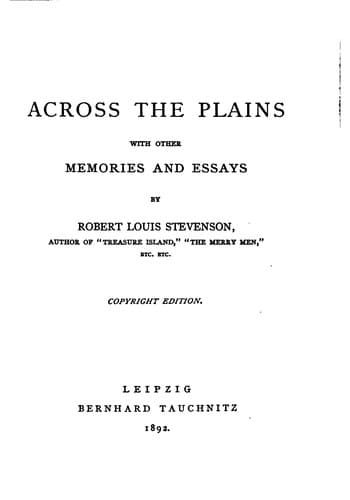
Across the Plains, with Other Memories and EssaysStevenson, Robert Louis
General
Across the Plains, with Other Memories and Essays
Stevenson, Robert Louis
Essays; Monterey (Calif.) -- Description and travel; West (U.S.) -- Description and travel
Here it was that my first tour of inspection began, early on a bleak
easterly morning. There was a crashing run of sea upon the shore, I
recollect, and my father and the man of the harbour light must sometimes
raise their voices to be audible. Perhaps it is from this circumstance,
that I always imagine St. Andrews to be an ineffectual seat of learning,
and the sound of the east wind and the bursting surf to linger in its
drowsy classrooms and confound the utterance of the professor, until
teacher and taught are alike drowned in oblivion, and only the sea-gull
beats on the windows and the draught of the sea-air rustles in the pages
of the open lecture. But upon all this, and the romance of St. Andrews
in general, the reader must consult the works of Mr. Andrew Lang; who has
written of it but the other day in his dainty prose and with his
incommunicable humour, and long ago in one of his best poems, with grace,
and local truth, and a note of unaffected pathos. Mr. Lang knows all
about the romance, I say, and the educational advantages, but I doubt if
he had turned his attention to the harbour lights; and it may be news
even to him, that in the year 1863 their case was pitiable. Hanging
about with the east wind humming in my teeth, and my hands (I make no
doubt) in my pockets, I looked for the first time upon that tragi-comedy
of the visiting engineer which I have seen so often re-enacted on a more
important stage. Eighty years ago, I find my grandfather writing: “It is
the most painful thing that can occur to me to have a correspondence of
this kind with any of the keepers, and when I come to the Light House,
instead of having the satisfaction to meet them with approbation and
welcome their Family, it is distressing when one-is obliged to put on a
most angry countenance and demeanour.” This painful obligation has been
hereditary in my race. I have myself, on a perfectly amateur and
unauthorised inspection of Turnberry Point, bent my brows upon the keeper
on the question of storm-panes; and felt a keen pang of self-reproach,
when we went down stairs again and I found he was making a coffin for his
infant child; and then regained my equanimity with the thought that I had
done the man a service, and when the proper inspector came, he would be
readier with his panes. The human race is perhaps credited with more
duplicity than it deserves. The visitation of a lighthouse at least is a
business of the most transparent nature. As soon as the boat grates on
the shore, and the keepers step forward in their uniformed coats, the
very slouch of the fellows’ shoulders tells their story, and the engineer
may begin at once to assume his “angry countenance.” Certainly the brass
of the handrail will be clouded; and if the brass be not immaculate,
certainly all will be to match—the reflectors scratched, the spare lamp
unready, the storm-panes in the storehouse. If a light is not rather
more than middling good, it will be radically bad.
Public-domain text, read in full here on John Shaqi.
Reviews
Reviews
No reviews yet
Be the first to share your thoughts on this work.
Elsewhere in the archive
Join the Discussion
Join the discussion
Sign in to leave a comment or review.
Sign InorCreate an account