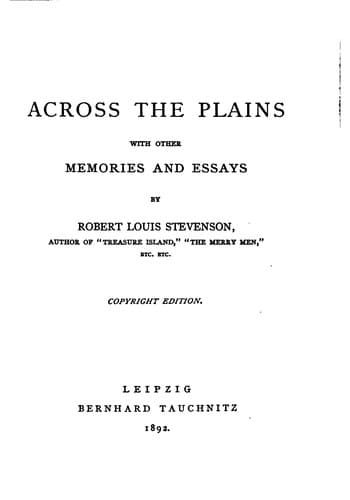
Across the Plains, with Other Memories and EssaysStevenson, Robert Louis
General
Across the Plains, with Other Memories and Essays
Stevenson, Robert Louis
Essays; Monterey (Calif.) -- Description and travel; West (U.S.) -- Description and travel
Mediocrity (except in
literature) appears to be unattainable by man. But of course the
unfortunate of St. Andrews was only an amateur, he was not in the
Service, he had no uniform coat, he was (I believe) a plumber by his
trade and stood (in the mediæval phrase) quite out of the danger of my
father; but he had a painful interview for all that, and perspired
extremely.
From St. Andrews, we drove over Magus Muir. My father had announced we
were “to post,” and the phrase called up in my hopeful mind visions of
top-boots and the pictures in Rowlandson’s _Dance of Death_; but it was
only a jingling cab that came to the inn door, such as I had driven in a
thousand times at the low price of one shilling on the streets of
Edinburgh. Beyond this disappointment, I remember nothing of that drive.
It is a road I have often travelled, and of not one of these journeys do
I remember any single trait. The fact has not been suffered to encroach
on the truth of the imagination. I still see Magus Muir two hundred
years ago; a desert place, quite uninclosed; in the midst, the primate’s
carriage fleeing at the gallop; the assassins loose-reined in pursuit,
Burley Balfour, pistol in hand, among the first. No scene of history has
ever written itself so deeply on my mind; not because Balfour, that
questionable zealot, was an ancestral cousin of my own; not because of
the pleadings of the victim and his daughter; not even because of the
live bum-bee that flew out of Sharpe’s ’bacco-box, thus clearly
indicating his complicity with Satan; nor merely because, as it was after
all a crime of a fine religious flavour, it figured in Sunday books and
afforded a grateful relief from _Ministering Children_ or the _Memoirs of
Mrs. Kathatine Winslowe_. The figure that always fixed my attention is
that of Hackston of Rathillet, sitting in the saddle with his cloak about
his mouth, and through all that long, bungling, vociferous hurly-burly,
revolving privately a case of conscience. He would take no hand in the
deed, because he had a private spite against the victim, and “that
action” must be sullied with no suggestion of a worldly motive; on the
other hand, “that action,” in itself, was highly justified, he had cast
in his lot with “the actors,” and he must stay there, inactive but
publicly sharing the responsibility. “You are a gentleman—you will
protect me!” cried the wounded old man, crawling towards him. “I will
never lay a hand on you,” said Hackston, and put his cloak about his
mouth. It is an old temptation with me, to pluck away that cloak and see
the face—to open that bosom and to read the heart. With incomplete
romances about Hackston, the drawers of my youth were lumbered. I read
him up in every printed book that I could lay my hands on. I even dug
among the Wodrow manuscripts, sitting shame-faced in the very room where
my hero had been tortured two centuries before, and keenly conscious of
Public-domain text, read in full here on John Shaqi.
Reviews
Reviews
No reviews yet
Be the first to share your thoughts on this work.
Elsewhere in the archive
Join the Discussion
Join the discussion
Sign in to leave a comment or review.
Sign InorCreate an account