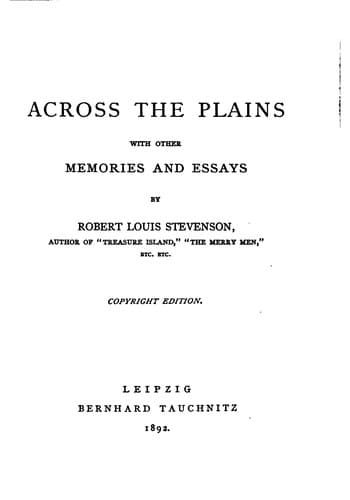
Across the Plains, with Other Memories and EssaysStevenson, Robert Louis
General
Across the Plains, with Other Memories and Essays
Stevenson, Robert Louis
Essays; Monterey (Calif.) -- Description and travel; West (U.S.) -- Description and travel
The Dutch widow was a person of some character. She had conceived at
first sight a great aversion for the present writer, which she was at no
pains to conceal. But being a woman of a practical spirit, she made no
difficulty about accepting my attentions, and encouraged me to buy her
children fruits and candies, to carry all her parcels, and even to sleep
upon the floor that she might profit by my empty seat. Nay, she was such
a rattle by nature, and, so powerfully moved to autobiographical talk,
that she was forced, for want of a better, to take me into confidence and
tell me the story of her life. I heard about her late husband, who
seemed to have made his chief impression by taking her out pleasuring on
Sundays. I could tell you her prospects, her hopes, the amount of her
fortune, the cost of her housekeeping by the week, and a variety of
particular matters that are not usually disclosed except to friends. At
one station, she shook up her children to look at a man on the platform
and say if he were not like Mr. Z.; while to me she explained how she had
been keeping company with this Mr. Z., how far matters had proceeded, and
how it was because of his desistance that she was now travelling to the
West. Then, when I was thus put in possession of the facts, she asked my
judgment on that type of manly beauty. I admired it to her heart’s
content. She was not, I think, remarkably veracious in talk, but
broidered as fancy prompted, and built castles in the air out of her
past; yet she had that sort of candour, to keep me, in spite of all these
confidences, steadily aware of her aversion. Her parting words were
ingeniously honest. “I am sure,” said she, “we all _ought_ to be very
much obliged to you.” I cannot pretend that she put me at my ease; but I
had a certain respect for such a genuine dislike. A poor nature would
have slipped, in the course of these familiarities, into a sort of
worthless toleration for me.
We reached Chicago in the evening. I was turned out of the cars, bundled
into an omnibus, and driven off through the streets to the station of a
different railroad. Chicago seemed a great and gloomy city. I remember
having subscribed, let us say sixpence, towards its restoration at the
period of the fire; and now when I beheld street after street of
ponderous houses and crowds of comfortable burghers, I thought it would
be a graceful act for the corporation to refund that sixpence, or, at the
least, to entertain me to a cheerful dinner. But there was no word of
restitution. I was that city’s benefactor, yet I was received in a
third-class waiting-room, and the best dinner I could get was a dish of
ham and eggs at my own expense.
Public-domain text, read in full here on John Shaqi.
Reviews
Reviews
No reviews yet
Be the first to share your thoughts on this work.
Join the Discussion
Join the discussion
Sign in to leave a comment or review.
Sign InorCreate an account