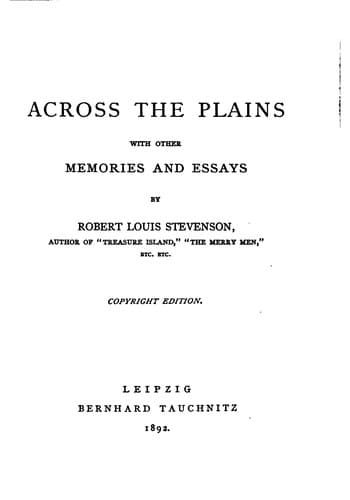
Across the Plains, with Other Memories and EssaysStevenson, Robert Louis
General
Across the Plains, with Other Memories and Essays
Stevenson, Robert Louis
Essays; Monterey (Calif.) -- Description and travel; West (U.S.) -- Description and travel
These writers would retort (if I take them properly) that this was very
true; that it was the same with themselves and other persons of (what
they call) the artistic temperament; that in this we were exceptional,
and should apparently be ashamed of ourselves; but that our works must
deal exclusively with (what they call) the average man, who was a
prodigious dull fellow, and quite dead to all but the paltriest
considerations. I accept the issue. We can only know others by
ourselves. The artistic temperament (a plague on the expression!) does
not make us different from our fellowmen, or it would make us incapable
of writing novels; and the average man (a murrain on the word!) is just
like you and me, or he would not be average. It was Whitman who stamped
a kind of Birmingham sacredness upon the latter phrase; but Whitman knew
very well, and showed very nobly, that the average man was full of joys
and full of a poetry of his own. And this harping on life’s dulness and
man’s meanness is a loud profession of incompetence; it is one of two
things: the cry of the blind eye, _I cannot see_, or the complaint of the
dumb tongue, _I cannot utter_. To draw a life without delights is to
prove I have not realised it. To picture a man without some sort of
poetry—well, it goes near to prove my case, for it shows an author may
have little enough. To see Dancer only as a dirty, old, small-minded,
impotently fuming man, in a dirty house, besieged by Harrow boys, and
probably beset by small attorneys, is to show myself as keen an observer
as . . . the Harrow boys. But these young gentlemen (with a more
becoming modesty) were content to pluck Dancer by the coat-tails; they
did not suppose they had surprised his secret or could put him living in
a book: and it is there my error would have lain. Or say that in the
same romance—I continue to call these books romances, in the hope of
giving pain—say that in the same romance, which now begins really to take
shape, I should leave to speak of Dancer, and follow instead the Harrow
boys; and say that I came on some such business as that of my
lantern-bearers on the links; and described the boys as very cold, spat
upon by flurries of rain, and drearily surrounded, all of which they
were; and their talk as silly and indecent, which it certainly was. I
might upon these lines, and had I Zola’s genius, turn out, in a page or
so, a gem of literary art, render the lantern-light with the touches of a
master, and lay on the indecency with the ungrudging hand of love; and
when all was done, what a triumph would my picture be of shallowness and
dulness! how it would have missed the point! how it would have belied the
boys! To the ear of the stenographer, the talk is merely silly and
indecent; but ask the boys themselves, and they are discussing (as it is
highly proper they should) the possibilities of existence. To the eye of
the observer they are wet and cold and drearily surrounded; but ask
Public-domain text, read in full here on John Shaqi.
Reviews
Reviews
No reviews yet
Be the first to share your thoughts on this work.
Elsewhere in the archive
Join the Discussion
Join the discussion
Sign in to leave a comment or review.
Sign InorCreate an account