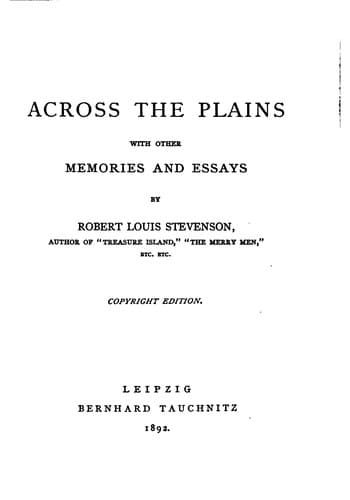
Across the Plains, with Other Memories and EssaysStevenson, Robert Louis
General
Across the Plains, with Other Memories and Essays
Stevenson, Robert Louis
Essays; Monterey (Calif.) -- Description and travel; West (U.S.) -- Description and travel
themselves, and they are in the heaven of a recondite pleasure, the
ground of which is an ill-smelling lantern.
III
For, to repeat, the ground of a man’s joy is often hard to hit. It may
hinge at times upon a mere accessory, like the lantern; it may reside,
like Dancer’s, in the mysterious inwards of psychology. It may consist
with perpetual failure, and find exercise in the continued chase. It has
so little bond with externals (such as the observer scribbles in his
note-book) that it may even touch them not; and the man’s true life, for
which he consents to live, lie altogether in the field of fancy. The
clergyman, in his spare hours, may be winning battles, the farmer sailing
ships, the banker reaping triumph in the arts: all leading another life,
plying another trade from that they chose; like the poet’s housebuilder,
who, after all, is cased in stone,
“By his fireside, as impotent fancy prompts.
Rebuilds it to his liking.”
In such a case the poetry runs underground. The observer (poor soul,
with his documents!) is all abroad. For to look at the man is but to
court deception. We shall see the trunk from which he draws his
nourishment; but he himself is above and abroad in the green dome of
foliage, hummed through by winds and nested in by nightingales. And the
true realism were that of the poets, to climb up after him like a
squirrel, and catch some glimpse of the heaven for which he lives.
And, the true realism, always and everywhere, is that of the poets: to
find out where joy resides, and give it a voice far beyond singing.
For to miss the joy is to miss all. In the joy of the actors lies the
sense of any action. That is the explanation, that the excuse. To one
who has not the secret of the lanterns, the scene upon the links is
meaningless. And hence the haunting and truly spectral unreality of
realistic books. Hence, when we read the English realists, the
incredulous wonder with which we observe the hero’s constancy under the
submerging tide of dulness, and how he bears up with his jibbing
sweetheart, and endures the chatter of idiot girls, and stands by his
whole unfeatured wilderness of an existence, instead of seeking relief in
drink or foreign travel. Hence in the French, in that meat-market of
middle-aged sensuality, the disgusted surprise with which we see the hero
drift sidelong, and practically quite untempted, into every description
of misconduct and dishonour. In each, we miss the personal poetry, the
enchanted atmosphere, that rainbow work of fancy that clothes what is
naked and seems to ennoble what is base; in each, life falls dead like
dough, instead of soaring away like a balloon into the colours of the
sunset; each is true, each inconceivable; for no man lives in the
external truth, among salts and acids, but in the warm, phantasmagoric
chamber of his brain, with the painted windows and the storied walls.
Public-domain text, read in full here on John Shaqi.
Reviews
Reviews
No reviews yet
Be the first to share your thoughts on this work.
Elsewhere in the archive
Join the Discussion
Join the discussion
Sign in to leave a comment or review.
Sign InorCreate an account