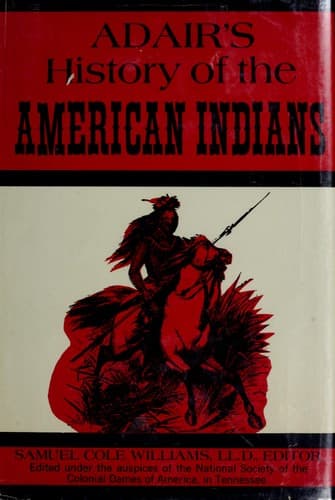
Adair's History of the American IndiansAdair, James
History
Adair's History of the American Indians
Adair, James
Indians -- Origin; Indians of North America -- Southern States
The verbs are seldom defective, or imperfect: though they may seem to be
so to persons who do not understand the idiom of their language, they
are not; they only appear as such by the near resemblance of words,
which convey a different meaning—as _A-kai-a_, “I go,” _Sa-kai-a_, “I am
satisfied with eating,” and _Sal-kai-a_, “I am angry, cross, vexed, or
disturbed in mind;” _Shee-a_, _Che-kai-a_, and _Chil-kai-a_, in the
second person; _Ai-a_, _E-kai-a_, and _Al-kai-a_, in the third person
singular. _A-pee-sa_ signifies “to see,” and _Al-pêê-sa_, “strait, even,
or right;” _Al-poo-ê-ak_, the general name of mercantile goods, I
subjoin, as such a word is uncommon with them; they seldom use so harsh
a termination. I shall here close this argument, and hope {73} enough
hath been said to give a clear idea of the principles of the Indian
language and dialects, its genius and idiom, and strong similarity to,
and near coincidence with the Hebrew—which will be not easily accounted
for, but by considering the American Indians as descended from the Jews.
ARGUMENT VI.
They count TIME after the manner of the Hebrews.
They divide the year into spring—summer—autumn, or the fall of the
leaf—and winter: which the Cheerake Indians call _Kogeh_, _Akooèa_,
_Oolekóhstè_, _Kòra_; and the Chikkasah and Choktah nation, _Otoolpha_,
_Tóme palle_, _Ashtòra-móona_, _Ashtòra_. _Kógeh_ is drawn from
_Anantòge_, the general appellation for the sun and moon; because, when
the sun returns from the southern hemisphere, he covers the vegetable
world with a green livery. _Akooèa_ alludes strongly to the essential
divine name, as we have seen in the former argument. With regard to
_Oolekohste_, “the fall of the leaf,” as they call a buzzard, _Soore_,
or _Soole_; and as _Soolekohste_ signifies troublesome, offensive,
disagreeable, the word signifies, that “the fall of the year is as
disagreeable a sight, as that of a buzzard.” _Kora_, as with the
Hebrews, signifies the winter; and is likewise the name of a bone: and
by joining _Hah_, an Hebrew note of admiration, to the end of it, as
_Kora-Hah_, it becomes the proper name of a man, signifying, “all
bones,” or very bony. _Otool-phà_, “the spring season,” is derived from
_Oolpha_, the name of a bud, or to shoot out; because then the solar
heat causes vegetables to bud and spring. _Tomeh_ signifies “the solar
light,” and _Palle_, “warm or hot;” _Ashtora_, “winter,” and _Moona_,
“presently,” &c.
Public-domain text, read in full here on John Shaqi.
Reviews
Reviews
No reviews yet
Be the first to share your thoughts on this work.
Elsewhere in the archive
Join the Discussion
Join the discussion
Sign in to leave a comment or review.
Sign InorCreate an account