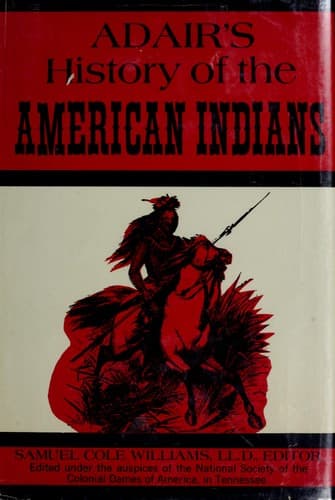
Adair's History of the American IndiansAdair, James
History
Adair's History of the American Indians
Adair, James
Indians -- Origin; Indians of North America -- Southern States
They number their years by any of those four periods, for they have no
name for a year; and they subdivide these, and count the year by lunar
months, like the Israelites, who counted by moons, as their name
sufficiently testifies; for they called them ירחים, the plural of ירח,
the moon. The Indians have no distinct proper name for the sun and moon;
one word, with a note of distinction, expresses both—for example; the
Cheerake {74} call the sun _Eus-se A-nan-tó-ge_, “the day-moon, or sun;”
and the latter, _Neus-se A-nan-tó-ge_, or “the night-sun, or moon.” In
like manner, the Chikkasah and Choktah term the one, _Neetak-Hasséh_,
and the other, _Neennak-Hasséh_; for _Neetak_ signifies “a day,” and
_Neennak_, “a night.”
Here I cannot forbear remarking, that the Indians call the penis of any
animal, by the very same name, _Hasse_; with this difference only, that
the termination is in this instance pronounced short, whereas the other
is long, on purpose to distinguish the words. This bears a strong
analogy to what the rabbins tell us of the purity of the Hebrew
language, that “it is so chaste a tongue, as to have no proper names for
the parts of generation.” The Cheerake can boast of the same decency of
style, for they call a corn-house, _Watóhre_ and the penis of any
creature, by the very same name; intimating, that as the sun and moon
influence and ripen the fruits that are stored in it, so by the help of
Ceres and Bacchus, Venus lies warm, whereas on the contrary, _sine
Cerere & Bacchus, friget Venus_.
They count certain very remarkable things, by knots of various colours
and make, after the manner of the South-American Aborigines; or by
notched square sticks, which are likewise distributed among the head
warriors, and other chieftains of different towns, in order to number
the winters, &c.—the moons also—their sleeps—and the days when they
travel; and especially certain secret intended acts of hostility. Under
such a circumstance, if one day elapses, each of them loosens a knot, or
cuts off a notch, or else makes one, according to previous agreement;
which those who are in the trading way among them, call broken days.
Thus they proceed day by day, till the whole time is expired, which was
marked out, or agreed upon; and they know with certainty, the exact time
of any of the aforesaid periods, when they are to execute their secret
purposes, be they ever so various. The authors of the romantic Spanish
histories of Peru and Mexico, have wonderfully stretched on these
knotted, or marked strings, and notched square sticks, to shew their own
fruitful inventions, and draw the attention and surprise of the learned
world to their magnified bundle of trifles.
Public-domain text, read in full here on John Shaqi.
Reviews
Reviews
No reviews yet
Be the first to share your thoughts on this work.
Elsewhere in the archive
Join the Discussion
Join the discussion
Sign in to leave a comment or review.
Sign InorCreate an account