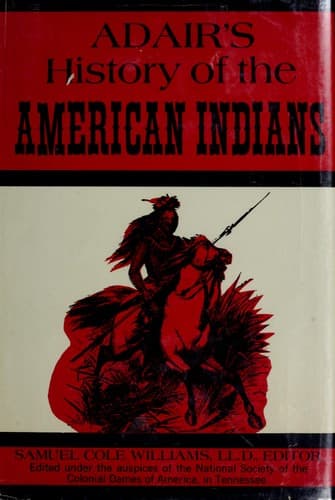
Adair's History of the American IndiansAdair, James
History
Adair's History of the American Indians
Adair, James
Indians -- Origin; Indians of North America -- Southern States
It is not surprizing that the dress of the old savage _Archi-magus_, and
that of the Levitical high-priest, is somewhat different. It may well be
supposed, they wandered from captivity to this far-distant wilderness,
in a distrest condition, where they could scarcely cover themselves from
the inclemency of heat and cold. Besides, if they had always been
possessed of the greatest affluence, the long want of written records
would sufficiently excuse the difference; because oral traditions are
liable to variation. However, there are some traces of agreement in
their pontifical dress. Before the Indian _Archi-magus_ officiates in
making the supposed holy fire, for the yearly atonement {82} of sin, the
Sagan clothes him with a white ephod, which is a waistcoat without
sleeves. When he enters on that solemn duty, a beloved attendant spreads
a white-drest buck-skin on the white seat, which stands close to the
supposed holiest, and then puts some white beads on it, that are given
him by the people. Then the _Archi-magus_ wraps around his shoulders a
consecrated skin of the same sort, which reaching across under his arms,
he ties behind his back, with two knots on the legs, in the form of a
figure of eight. Another custom he observes on this solemn occasion, is,
instead of going barefoot, he wears a new pair of buck-skin white
maccasenes made by himself, and stitched with the sinews of the same
animal[XXI]. The upper leather across the toes, he paints, for the space
of three inches, with a few streaks of red—not with vermilion, for that
is their continual war-emblem, but with a certain red root, its leaves
and stalk resembling the ipecacuanha, which is their fixed red symbol of
holy things. These shoes he never wears, but in the time of the supposed
passover; for at the end of it, they are laid up in the beloved place,
or holiest, where much of the like sort, quietly accompanies an heap of
old, broken earthen ware, conch-shells, and other consecrated things.
Footnote XXI:
Observant ubi sesta mero pede sabbata reges,
Et vetus indulget senibus clementa porcis.
JUVENAL, Sat. vi.
When the high-priest entered into the holiest, on the day of
expiation, he clothed himself in white; and, when he finished that
day’s service, he laid aside those clothes and left them in the
tabernacle. _Lev._ xvi. 23.
When the Egyptian priests went to worship in their temples, they wore
shoes of white parchment. HERODOTUS, Lib. ii. Cap. v.
Public-domain text, read in full here on John Shaqi.
Reviews
Reviews
No reviews yet
Be the first to share your thoughts on this work.
Elsewhere in the archive
Join the Discussion
Join the discussion
Sign in to leave a comment or review.
Sign InorCreate an account