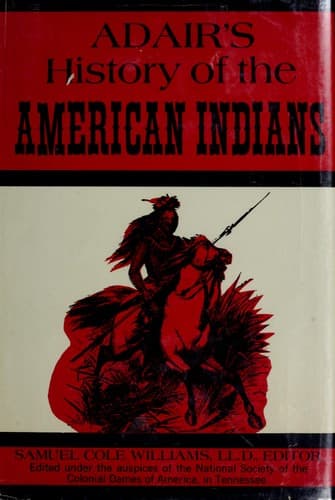
Adair's History of the American IndiansAdair, James
History
Adair's History of the American Indians
Adair, James
Indians -- Origin; Indians of North America -- Southern States
The Mosaic ceremonial institutions, are acknowledged by our best
writers, to represent the Messiah, under various types and shadows; in
like manner, the religious customs of the American Indians, seem to
typify the same; according to the early divine promise, that the seed of
the woman should bruise the head of the serpent; and that it should
bruise his heel.—The Levitical high-priest wore a _breast-plate_, which
they called _Hosechim_, and on it the _Urim_ and _Thummim_, signifying
lights and perfections; for they are the plurals of אור, _Awóra_, (which
inverted makes _Erowa_) and תורה, _Thòràh_, {83} the law, as it directed
them under dark shadows, to Messiah, the lamp of light and perfection.
In resemblance of this sacred pectoral, or breast-plate, the American
_Archi-magus_ wears a breast-plate, made of a white conch-shell,[34]
with two holes bored in the middle of it, through which he puts the ends
of an otter-skin strap, and fastens a buck-horn white button to the
outside of each, as if in imitation of the precious stones of Urim,
which miraculously blazoned from the high-priest’s breast, the unerring
words of the divine oracle. Instead of the plate of gold, which the
Levite wore on his forehead, bearing these words,קדש לי יהוה _Kadesh li
Yohewah_, “holy, or separate to God,” the Indian wears around his
temples, either a wreath of swan-feathers, or a long piece of swan-skin
doubled, so as only the fine snowy feathers appear on each side. And, in
likeness to the _Tiara_ of the former, the latter wears on the crown of
his head, a tuft of white feathers, which they call _Yatèra_. He
likewise fastens a tuft of blunted wild Turkey cock-spurs, toward the
toes of the upper part of his maccasenes, as if in resemblance to the
seventy-two bells, which the Levitical high-priest wore on his coat of
blue. Those are as strong religious pontifical emblems, as any old
Hebrews could have well chosen, or retained under the like circumstances
of time and place. Thus appears the Indian Archimagus—not as _Merubha
Begadim_, “the man with many clothes,” as they called the high-priest of
the second temple, but with clothes proper to himself, when he is to
officiate in his pontifical function, at the annual expiation of
sins[XXII]. As religion is the touchstone of every nation of people, and
as these Indians cannot be supposed to have been deluded out of theirs,
separated from the rest of the world, for many long-forgotten ages—the
traces which may be discerned among them, will help to corroborate the
other arguments concerning their origin.
Footnote XXII:
The only ornaments that distinguished the high-priest from the rest,
were a coat with seventy-two bells, an ephod, or jacket without
sleeves, a breast-plate set with twelve stones, a linen mitre, and a
plate of gold upon his forehead.
Public-domain text, read in full here on John Shaqi.
Reviews
Reviews
No reviews yet
Be the first to share your thoughts on this work.
Elsewhere in the archive
Join the Discussion
Join the discussion
Sign in to leave a comment or review.
Sign InorCreate an account