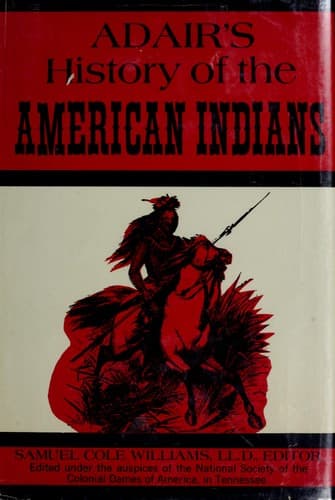
Adair's History of the American IndiansAdair, James
History
Adair's History of the American Indians
Adair, James
Indians -- Origin; Indians of North America -- Southern States
These religious, beloved men are also supposed to be in great favour
with the Deity, and able to procure rain when they please. In this
respect also, we shall observe a great conformity to the practice of the
Jews. The Hebrew records inform us, that in the moon _Abib_, or Nisan,
they prayed for {84} the spring, or latter rain, to be so seasonable and
sufficient as to give them a good harvest. And the Indian Americans have
a tradition, that their forefathers sought for and obtained such
seasonable rains, as gave them plentiful crops; and they now seek them
in a manner agreeable to the shadow of this tradition.
When the ground is parched, their _rain-makers_, (as they are commonly
termed) are to mediate for the beloved red people, with the bountiful
holy Spirit of fire. But their old cunning prophets are not fond of
entering on this religious duty, and avoid it as long as they possibly
can, till the murmurs of the people force them to the sacred attempt,
for the security of their own lives. If he fails,[35] the prophet is
shot dead, because they are so credulous of his divine power conveyed by
the holy Spirit of fire, that they reckon him an enemy to the state, by
averting the general good, and bringing desolating famine upon the
beloved people. But in general, he is so discerning in the stated laws
of nature, and skilful in priestcraft, that he always seeks for rain,
either at the full, or change of the moon; unless the birds, either by
instinct, or the temperature of their bodies, should direct him
otherwise. However, if in a dry season, the clouds, by the veering of
the winds, pass wide of their fields—while they are inveighing bitterly
against him, some in speech, and others in their hearts, he soon changes
their well-known notes—he assumes a displeased countenance and carriage,
and attacks them with bitter reproaches, for their vicious conduct in
the marriage-state, and for their notorious pollutions, by going to the
women in their religious retirements, and for multifarious crimes that
never could enter into his head to suspect them of perpetrating, but
that the divinity his holy things were endued with, had now suffered a
great decay, although he had fasted, purified himself, and on every
other account, had lived an innocent life, according to the old beloved
speech: adding, “_Loak Ishtohoollo_ will never be kind to bad people.”
He concludes with a religious caution to the penitent, advising them to
mend their manners, and the times will mend with them: Then they depart
with sorrow and shame. The old women, as they go along, will exclaim
loudly against the young people, and protest they will watch their
manners very narrowly for the time to come, as they are sure of their
own steady virtue. {85}
Public-domain text, read in full here on John Shaqi.
Reviews
Reviews
No reviews yet
Be the first to share your thoughts on this work.
Elsewhere in the archive
Join the Discussion
Join the discussion
Sign in to leave a comment or review.
Sign InorCreate an account