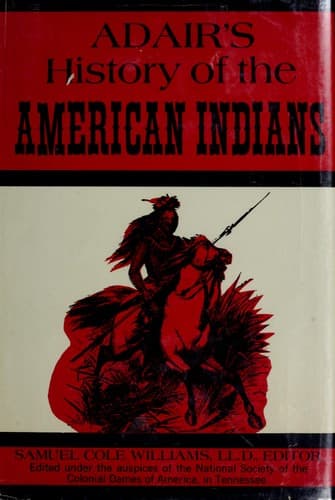
Adair's History of the American IndiansAdair, James
History
Adair's History of the American Indians
Adair, James
Indians -- Origin; Indians of North America -- Southern States
Their FESTIVALS, FASTS, and RELIGIOUS RITES, have also a great
resemblance to those of the Hebrews. It will be necessary here to take a
short view of the principal Jewish feasts, &c. They kept every year, a
sacred feast called the Passover, in memory of their deliverance from
Egyptian {94} bondage. Seven days were appointed, _Lev._ xxiii.—To these
they added an eighth, through a religious principle, as preparatory, to
clear their houses of all leaven, and to fix their minds before they
entered on that religious duty. The name of this festival is derived
from a word which signifies to “pass over;” because, when the destroying
angel flew through the Egyptian houses, and killed their first-born, he
passed over those of the Israelites, the tops of whose doors were
stained with the blood of the lamb, which they were ordered to kill.
This solemnity was instituted with the strongest injunctions, to let
their children know the cause of that observance, and to mark that night
through all their generations.
Three days before this sacred festival, they chose a lamb, without spot
or blemish, and killed it on the evening of the fourteenth day of Abib,
which was the first moon of the ecclesiastical, and the seventh of the
civil year; and they ate it with bitter herbs, without breaking any of
the bones of it, thus prefiguring the death of Messiah. This was the
reason that this was the chief of the days of unleavened bread, and they
were strictly forbidden all manner of work on that day; besides, no
uncircumcised, or unclean persons ate of the paschal lamb. Those of the
people, whom diseases or long journies prevented from observing the
passover on that day, were obliged to keep it in the next moon.
On the fifteenth day, which was the second of the passover, they offered
up to God a sheaf of the new barley-harvest, because it was the earliest
grain. The priest carried it into the temple, and having cleaned and
parched it, he grinded or pounded it into flower, dipt it in oil, and
then waved it before the Lord, throwing some into the fire. The Jews
were forbidden to eat any of their new harvest, till they had offered up
a sheaf, the grain of which filled an omer, a small measure of about
five pints. All was impure and unholy till this oblation was made, but
afterwards it became hallowed, and every one was at liberty to reap and
get in his harvest.
Public-domain text, read in full here on John Shaqi.
Reviews
Reviews
No reviews yet
Be the first to share your thoughts on this work.
Elsewhere in the archive
Join the Discussion
Join the discussion
Sign in to leave a comment or review.
Sign InorCreate an account