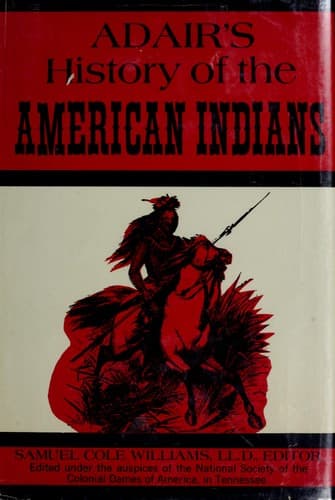
Adair's History of the American IndiansAdair, James
History
Adair's History of the American Indians
Adair, James
Indians -- Origin; Indians of North America -- Southern States
On the tenth day of the moon Ethanim, the first day of the civil year,
they celebrated the great fast, or feast of expiation, afflicted their
souls, and ate nothing the whole day. The high-priest offered several
sacrifices, and having carried the blood of the victims into the temple,
he sprinkled it upon the altar of incense, and the veil that was before
the holiest; and went {95} into that most sacred place, where the divine
Shekinah resided, carrying a censer smoking in his hand with incense,
which hindered him from having a clear sight of the ark. But he was not
allowed to enter that holy place, only once a year, on this great day of
expiation, to offer the general sacrifice both for the sins of the
people and of himself. Nor did he ever mention the divine four-lettered
name, YO HE WAH, except on this great day, when he blessed the people.
Because the Israelites lived in tabernacles, or booths, while they were
in the wilderness; as a memorial therefore of the divine bounty to them,
they were commanded to keep the feast of tabernacles, on the fifteenth
day of the month Tisri, which they called _Rosh Hosanah_, or
_Hoshianah_, it lasted eight days; during which time, they lived in
arbours, (covered with green boughs of trees) unless when they went to
worship at the temple, or sung _Hoshaniyo_ around the altar. When they
were on this religious duty, they were obliged each to carry in their
hands a bundle of the branches of willows, palm-trees, myrtles, and
others of different sorts, laden with fruit, and tied together with
ribbons; and thus rejoice together with the appointed singers, and vocal
and instrumental music, in the divine presence before the altar. On the
eighth day of the feast, one of the priests brought some water in a
golden vessel, from the pool of Siloam, mixed it with wine, and poured
it on the morning-sacrifice, and the first fruits of their latter crops
which were then presented, as an emblem of the divine graces that should
flow to them, when Shilo came, who was to be their anointed king,
prophet, and high-priest—The people in the mean time singing out of
Isaiah “with joy shall ye draw water out of the wells of salvation.”
Public-domain text, read in full here on John Shaqi.
Reviews
Reviews
No reviews yet
Be the first to share your thoughts on this work.
Elsewhere in the archive
Join the Discussion
Join the discussion
Sign in to leave a comment or review.
Sign InorCreate an account