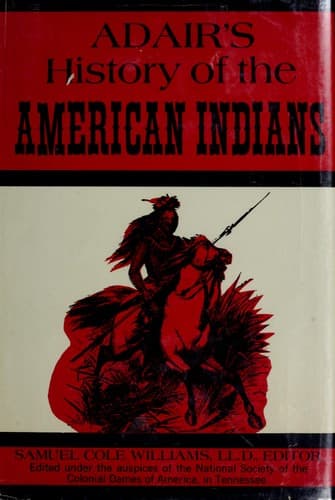
Adair's History of the American IndiansAdair, James
History
Adair's History of the American Indians
Adair, James
Indians -- Origin; Indians of North America -- Southern States
Before noon, the temple is so cleared of every thing the women brought
to the square, that the festival after that period, resembles a magical
entertainment that had no reality in it, consisting only in a delusion
of the senses. The women then carry the vessels from the temple to the
water, and wash them clean for fear of pollution. As soon as the sun is
visibly declining from his meridian, this third day of the fast, the
_Archi-magus_ orders a religious attendant to cry aloud to the crowded
town, that the holy fire is to be brought out for the sacred
altar—commanding every one of them to stay within their own houses, as
becomes the beloved people, without doing the least bad thing—and to be
sure to extinguish, and throw away every spark of the old fire;
otherwise, the divine fire will bite them severely with bad diseases,
sickness, and a great many other evils, which he sententiously
enumerates, and finishes his monitory caution, by laying life and death
before them.
Now every thing is hushed.—Nothing but silence all around: the
_Archi-magus_, and his beloved waiter, rising up with a reverend
carriage, steady countenance, and composed behaviour, go into the
beloved place, or holiest, to bring them out the beloved fire. The
former takes a piece of dry poplar, willow, or white oak, and having cut
a hole, so as not to reach through it, he then sharpens another piece,
and placing that with the hole between his knees, he drills it briskly
for several minutes, till it begins to smoke—or, by rubbing two pieces
together, for about a quarter of an hour, by friction he collects the
hidden fire; which all of them reckon to immediately issue from the holy
Spirit of fire. The Muskohge call the fire their grandfather—and the
supreme Father of mankind, _Esakàta-Emishe_, “the breath master,” as it
is commonly explained. When the fire appears, the beloved waiter
cherishes it with fine chips, or shaved splinters of pitch-pine, which
had been deposited in the holiest; then he takes the unsullied wing of a
swan, fans it gently, and cherishes it to a flame. On this, the
_Archi-magus_ brings it out in an old earthen vessel, whereon he had
placed it, and lays it on the sacred altar, which is under an arbour,
thick-weaved a-top with green boughs. It is observable, that when the
Levites laid wood on the sacred fire, it was unlawful {105} for them
either to blow it with bellows, or their breath. The Magians, or
followers of Zoroaster, poured oil on their supposed holy fire, and left
it to the open air to kindle it into flame. Is not this religious
ceremony of these desolate Indians a strong imitation, or near
resemblance of the Jewish customs?
Public-domain text, read in full here on John Shaqi.
Reviews
Reviews
No reviews yet
Be the first to share your thoughts on this work.
Elsewhere in the archive
Join the Discussion
Join the discussion
Sign in to leave a comment or review.
Sign InorCreate an account