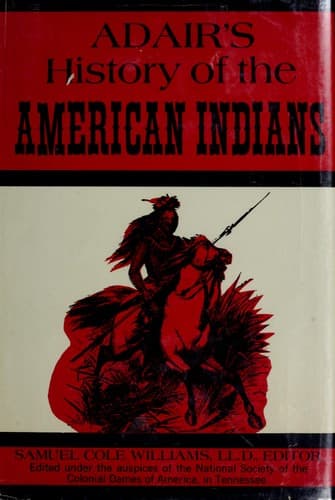
Adair's History of the American IndiansAdair, James
History
Adair's History of the American Indians
Adair, James
Indians -- Origin; Indians of North America -- Southern States
otherwise they will get full of worms, and be devoured by famine and
diseases, and bring many other dangerous evils both upon themselves, and
all the beloved, or holy people. This seems to allude to the theocratic
government of the Jews, when such daring criminals were afflicted with
immediate and visible divine punishment.
In his female lecture, he is sharp and prolix: he urges them with much
earnestness to an honest observance of the marriage-law, which may be
readily excused, on account of the prevalent passion of self-interest.
Our own Christian orators do not exert themselves with half the
eloquence or eagerness, as when that is at stake which they most value.
And the old wary savage has sense enough to know, that the Indian female
virtue is very brittle, not being guarded so much by inward principle,
as the fear of shame, and of incurring severe punishment; but if every
bush of every thicket was an hundred-eyed Argos, it would not be a
sufficient guard over a wanton heart. So that it is natural they should
speak much on this part of the subject, as they think they have much at
stake. After that, he addresses himself to the whole body of the people,
and tells them, in rapid bold language, with great energy, and
expressive gestures of body, to look at the holy fire, which again has
introduced all those shameful adulterous criminals into social
privileges; he bids them not to be guilty of the like for time to come,
but be sure to remember well, and strongly shake hands with the old
beloved straight speech, otherwise the divine fire, which sees, hears,
and knows them, will spoil them exceedingly, if at any time they
relapse, and commit that detestable crime. Then he numerates all the
supposed lesser crimes, and moves the audience by the great motives of
the hope of temporal good, and the fear of temporal evil, assuring them,
that upon their careful observance of the ancient law, the holy fire
will enable their prophets, the rain-makers, to procure them plentiful
harvests, and give their war-leaders victory over their enemies—and by
the {107} communicative power of their holy things, health and
prosperity are certain: but on failure, they are to expect a great many
extraordinary calamities, such as hunger, uncommon diseases, a
subjection to witchcraft, and captivity and death by the hands of the
hateful enemy in the woods, where the wild fowls will eat their flesh,
and beasts of prey destroy the remaining bones, so as they will not be
gathered to their forefathers—because their ark abroad, and beloved
things at home, would lose their virtual power of averting evil. He
concludes, by advising them to a strict observance of their old rites
and customs, and then every thing shall go well with them. He soon
orders some of the religious attendants to take a sufficient quantity of
the supposed holy fire, and lay it down on the outside of the holy
ground, for all the houses of the various associated towns, which
sometimes lie several miles apart.
Public-domain text, read in full here on John Shaqi.
Reviews
Reviews
No reviews yet
Be the first to share your thoughts on this work.
Elsewhere in the archive
Join the Discussion
Join the discussion
Sign in to leave a comment or review.
Sign InorCreate an account