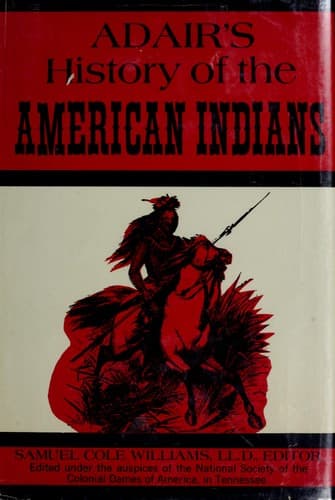
Adair's History of the American IndiansAdair, James
History
Adair's History of the American Indians
Adair, James
Indians -- Origin; Indians of North America -- Southern States
When we consider how sparingly they eat in their usual way of living, it
is surprising to see what a vast quantity of food they consume {109} on
their festival days. It would equally surprize a stranger to see how
exceedingly they vary their dishes, their dainties consisting only of
dried flesh, fish, oil, corn, beans, pease, pompions, and wild fruit.
During this rejoicing time, the warriors are drest in their wild martial
array, with their heads covered with white down: they carry feathers of
the same colour, either in their hands, or fastened to white scraped
canes, as emblems of purity, and scepters of power, while they are
dancing in three circles, and singing their religious praises around the
sacred arbour, in which stands the holy fire. Their music consists of
two clay-pot drums covered on the top with thin wet deer-skins, drawn
very tight, on which each of the noisy musicians beats with a stick,
accompanying the noise with their voices; at the same time, the dancers
prance it away, with wild and quick sliding steps, and variegated
postures of body, to keep time with the drums, and the rattling
calabashes shaked by some of their religious heroes, each of them
singing their old religious songs, and striking notes _in tympano et
choro_. Such is the graceful dancing, as well as the vocal and
instrumental music of the red Hebrews on religious and martial
occasions, which they must have derived from early antiquity. Toward the
conclusion of the great festival, they paint and dress themselves anew,
and give themselves the most terrible appearance they possibly can. They
take up their war-instruments, and fight a mock-battle in a very exact
manner: after which, the women are called to join in a grand dance, and
if they disobey the invitation they are fined. But as they are extremely
fond of such religious exercise, and deem it productive of temporal
good, all soon appear in their finest apparel, as before suggested,
decorated with silver ear-bobs, or pendants to their ears, several
rounds of white beads about their necks, rings upon their fingers, large
wire or broad plates of silver on their wrists, their heads shining with
oil, and torrepine-shells containing pebbles, fastened to deer-skins,
tied to the outside of their legs. Thus adorned, they join the men in
three circles, and dance a considerable while around the sacred fire,
and then they separate.
Public-domain text, read in full here on John Shaqi.
Reviews
Reviews
No reviews yet
Be the first to share your thoughts on this work.
Elsewhere in the archive
Join the Discussion
Join the discussion
Sign in to leave a comment or review.
Sign InorCreate an account