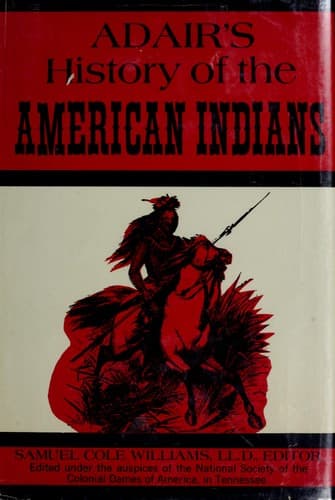
Adair's History of the American IndiansAdair, James
History
Adair's History of the American Indians
Adair, James
Indians -- Origin; Indians of North America -- Southern States
Ancient writers inform us, that while the Scythians or Tartars were
heathens, their priests in the time of their sacrifices, took some
blood, and mixing it with milk, horse-dung, and earth, got on a tree,
and having exhorted the people, they sprinkled them with it, in order to
purify them, and defend them from every kind of evil: the heathens also
excluded some from religious communion. The Egyptians excommunicated
those who ate of animals that bore wool, or cut the throat of a
goat[XXV]. And in ancient times, they, and the Phœnicians, Greeks, &c.
adored the serpent, and expelled those who killed it. The East-Indians
likewise, drive those from the {111} supposed benefit of their altars,
who eat of a cow, and drink wine, or that eat with foreigners, or an
inferior cast. Though the heathen world offered sacrifice, had
ablutions, and several other sorts of purifications, and frequently by
fire; yet at the best, their religious observances differed widely from
the divine institutions; whereas the American Aborigines observe strict
purity, in the most essential parts of the divine law. The former
concealed their various worship from the light of the sun; some seeking
thick groves, others descending into the deep valleys, others crawling
to get into caverns, and under their favourite rocks. But we find the
latter, in their state-houses and temples, following the Jerusalem copy
in a surprizing manner. Those of them who yet retain a supposed most
holy place, contrary to the usage of the old heathen world, have it
standing at the west end of the holy quadrangular ground: and they
always appoint those of the meanest rank, to sit on the seats of the
eastern square, so that their backs are to the east, and faces to the
west[XXVI]. The red square looks north; and the second men’s cabbin, as
the traders term the other square, of course looks south, which is a
strong imitation of Solomon’s temple, that was modelled according to the
divine plan of the Israelitish camp in the wilderness. We find them also
sanctifying themselves, according to the emblematical laws of purity,
offering their annual sacrifice in the centre of their quadrangular
temples, under the meridian light of the sun. Their magi are devoted to,
and bear the name of the great holy One; their supposed prophets
likewise that of the divine fire; and each of them bear the emblems of
purity and holiness—while in their religious duties, they sing ALELUIAH,
YO HE WAH, &c. both day and night. Thus different are the various gods,
{112} temples, prophets, and priests of all the idolatrous nations of
antiquity, from the savage Americans; which shews with convincing
clearness, especially by recollecting the former arguments, that the
American Aborigines were never idolaters, nor violated the second
commandment in worshipping the incomprehensible, omnipresent, divine
essence, after the manner described by the popish historians of Peru and
Public-domain text, read in full here on John Shaqi.
Reviews
Reviews
No reviews yet
Be the first to share your thoughts on this work.
Elsewhere in the archive
Join the Discussion
Join the discussion
Sign in to leave a comment or review.
Sign InorCreate an account