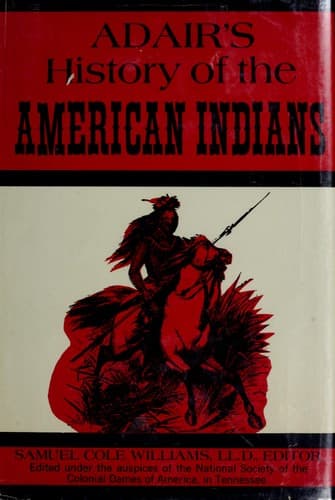
Adair's History of the American IndiansAdair, James
History
Adair's History of the American Indians
Adair, James
Indians -- Origin; Indians of North America -- Southern States
Mexico; but that the greatest part of their civil and religious system,
is a strong old picture of the Israelitish, much less defaced than might
be reasonably expected from the circumstances of time and place.
Footnote XXV:
——Lanatis animalibus abstinet omnis
Mensa; nefas illic fætum jugulare capellæ.
JUVENAL, Sat. xv.
Footnote XXVI:
The Hebrews had two presidents in the great synhedrion. The first was
called _Nashe Yo_, “a prince of God.” They elected him on account of
his wisdom: The second was called _Rosh Ha-Yoshibbah_, “the father of
the assembly:” he was chief in the great council. And _Ab beth din_,
or “the father of the consistory,” sat at his right hand, as the chief
of the seventy-two, of which the great synhedrion consisted, the rest
sitting according to their merit, in a gradual declension from the
prince, to the end of the semicircle. The like order is observed by
the Indians,—and _Jer._ ii. 27, God commanded the Israelites, that
they should not turn their backs to him, but their faces toward the
propitiatory, when they worshipped him. I remember, in Koosah, the
uppermost western town of the Muskohge, which was a place of refuge,
their supposed holiest consisted of a neat house, in the centre of the
western square, and the door of it was in the south gable-end close to
the white cabbin, each on a direct line, north and south.
Every spring season, one town or more of the Missisippi Floridians,[40]
keep a great solemn feast of love, to renew their old friendship. They
call this annual feast, _Hottuk Aimpa, Heettla, Tanáa_, “the people eat,
dance, and walk as twined together”—The short name of their yearly feast
of love, is _Hottuk Impanáa_, “eating by a strong religious, or social
principle;” _Impanáa_ signifies several threads or strands twisted, or
warped together. _Hissoobistarákshe_, and _Yelphòha Panáa_, is “a
twisted horse-rope,” and “warped garter[XXVII].” This is also contrary
to the usage of the old heathen world, whose festivals were in honour to
their chief idols, and very often accompanied with detestable lewdness
and debauchery.
Footnote XXVII:
The name of a horse-rope is derived from _Tarákshe_ “to tie,” and
_Hissooba_ “an elk, or horse that carries a burthen;” which suggests
that they formerly saw elks carry burthens, though perhaps not in the
northern provinces.
Public-domain text, read in full here on John Shaqi.
Reviews
Reviews
No reviews yet
Be the first to share your thoughts on this work.
Elsewhere in the archive
Join the Discussion
Join the discussion
Sign in to leave a comment or review.
Sign InorCreate an account