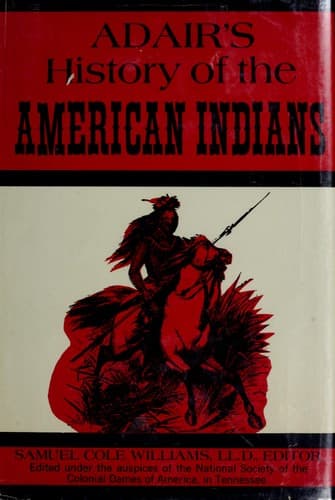
Adair's History of the American IndiansAdair, James
History
Adair's History of the American Indians
Adair, James
Indians -- Origin; Indians of North America -- Southern States
The more religious, or the least corrupted, of the various remote Indian
nations, will not eat of any young beast when it is newly yeaned; and
their old men think they would suffer damage, even by the bare contact:
which seems to be derived from the Mosaic law, that prohibited such
animals to be offered up, or eaten, till they were eight days old;
because, till then, they were in an imperfect and polluted state! They
appear, however, to be utterly ignorant of the design and meaning of
this appointment and practice, as well as of some other customs and
institutions. But as the time of circumcising the Israelitish children
was founded on this law of purity, it seems probable, that the American
Aborigines observed the law of circumcision,[52] for some time after
they arrived here, and desisted from it, when it became incompatible
with the hard daily toils and sharp exercises, which necessity must have
forced them to pursue, to support life: especially when we consider,
that the sharpest and most lasting affront, the most opprobious,
indelible epithet, with which one Indian can possibly brand another, is
to call him in public company, _Hoobuk Waske_, Eunuchus, præputio
detecto. They resent it so highly, that in the year {136} 1750, when the
Cheerakee were on the point of commencing a war against us, several
companies of the northern Indians, in concert with them, compelled me in
the lower Cheerakee town to write to the government of South-Carolina,
that they made it their earnest request to the English not to mediate in
their war with the Katáhba Indians, as they were fully resolved to
prosecute it, with the greatest eagerness, while there was one of that
hateful name alive; because in the time of battle, they had given them
the ugly name of short-tailed eunuchs. Now as an eunuch was a
contemptible name with the Israelites, and none of them could serve in
any religious office; it should seem that the Indians derived this
opprobious and singular epithet from Jewish tradition, as castration was
never in use among the ancient or present Americans.
Public-domain text, read in full here on John Shaqi.
Reviews
Reviews
No reviews yet
Be the first to share your thoughts on this work.
Elsewhere in the archive
Join the Discussion
Join the discussion
Sign in to leave a comment or review.
Sign InorCreate an account