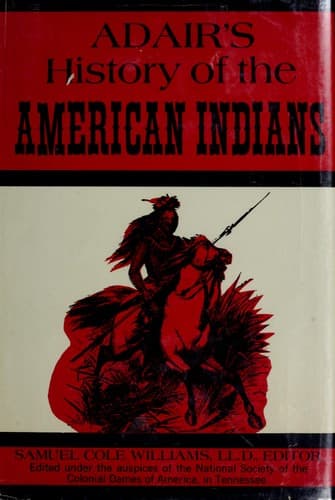
Adair's History of the American IndiansAdair, James
History
Adair's History of the American Indians
Adair, James
Indians -- Origin; Indians of North America -- Southern States
The Israelites were but forty years in the wilderness, and would not
have renewed the painful act of circumcision, only that Joshua inforced
it: and by the necessary fatigues and difficulties, to which as already
hinted, the primitive Americans must be exposed at their first arrival
in this waste and extensive wilderness, it is likely they forbore
circumcision, upon the divine principle extended to their supposed
predecessors in the wilderness, of not accepting sacrifice at the
expence of mercy. This might soothe them afterwards wholly to reject it
as a needless duty, especially if any of the eastern heathens
accompanied them in their travels in quest of freedom. And as it is
probable, that by the time they reached America, they had worn out their
knives and every other sharp instrument fit for the occasion; so had
they performed the operation with flint-stones, or sharp splinters,
there is no doubt that each of the mothers would have likewise said,
“This day, thou art to me a bloody husband[XXIX].” However, from the
contemptible idea the Americans fix to castration, &c. it seems very
probable the more religious among them used circumcision in former ages.
Footnote XXIX:
Exod. iv. 25, 26.
Under this argument, I must observe that _Ai-ú-be_ signifies “the thigh”
of any animal; and _E-ee-pattáh Tekále_, “the lower part of the thigh,”
or literally, “the hanging of the foot.” And when in the woods, the
Indians cut a small piece out of the lower part of the thighs of the
deer they kill, length-ways and pretty deep. Among the great number of
venison-hams they bring to our trading houses, I do not remember to
{137} have observed one without it; from which I conjecture, that as
every ancient custom was designed to convey, either a typical, or
literal instructive lesson of some useful thing; and as no usage of the
old heathen world resembled this custom; it seems strongly to point at
Jacob’s wrestling with an angel, and obtaining for himself and his
posterity, the name, ישר-אל, (perhaps, _Yosher-ale_) “divine guide,” or
“one who prevails with the omnipotent,” and to the children of Israel
not eating the sinew of the thigh of any animal, to perpetuate the
memory of their ancestor’s sinew being shrunk, which was to obtain the
blessing.
Public-domain text, read in full here on John Shaqi.
Reviews
Reviews
No reviews yet
Be the first to share your thoughts on this work.
Elsewhere in the archive
Join the Discussion
Join the discussion
Sign in to leave a comment or review.
Sign InorCreate an account