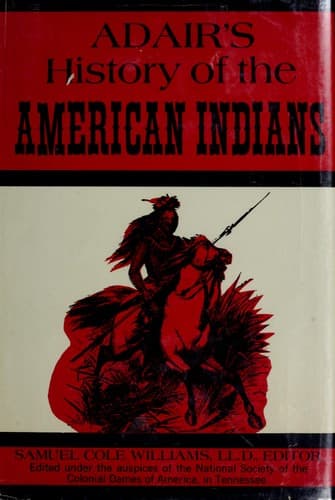
Adair's History of the American IndiansAdair, James
History
Adair's History of the American Indians
Adair, James
Indians -- Origin; Indians of North America -- Southern States
The Indians always sew their maccasenes with deer’s sinews, though of a
sharp cutting quality, for they reckon them more fortunate than the wild
hemp: but to eat such, they imagine would breed worms, and other
ailments, in proportion to the number they eat. And I have been assured
by a gentleman of character, who is now an inhabitant of South-Carolina,
and well acquainted with the customs of the northern Indians, that they
also cut a piece out of the thigh of every deer they kill, and throw it
away; and reckon it such a dangerous pollution to eat it, as to occasion
sickness and other misfortunes of sundry kinds, especially by spoiling
their guns from shooting with proper force and direction. Now as none of
the old heathens had such a custom, must it not be considered as of
Israelitish extraction.[53]
ARGUMENT XIII.
The Indian MARRIAGES, DIVORCES, and PUNISHMENTS of adultery, still
retain a strong likeness to the Jewish laws and customs in these points.
The Hebrews had sponsalia de presenti, and sponsalia de futuro: a
considerable time generally intervened between their contract and
marriage: and their nuptial ceremonies were celebrated in the night. The
Indians observe the same customs to this day; insomuch, that it is usual
for an elderly man to take a girl, or sometimes a child to be his wife,
because she is capable of receiving good impressions in that tender
state: frequently, a moon elapses after the contract is made, and the
value received, before {138} the bridegroom sleeps with the bride, and
on the marriage day, he does not appear before her till night introduces
him, and then without tapers.
The grandeur of the Hebrews consisted pretty much in the multiplicity of
their wives to attend them, as a showy retinue: as the meaner sort could
not well purchase one, they had a light sort of marriage suitable to
their circumstances, called by the scholiasts, _usu capio_; “taking the
woman for present use.” When they had lived together about a year, if
agreeable, they parted good friends by mutual consent. The Indians also
are so fond of variety, that they ridicule the white people, as a tribe
of narrow-hearted, and dull constitutioned animals, for having only one
wife at a time; and being bound to live with and support her, though
numberless circumstances might require a contrary conduct. When a young
warrior cannot dress _alamode America_, he strikes up one of those
matches for a few moons, which they term _Toopsa Táwah_, “a make haste
marriage,” because it wants the usual ceremonies, and duration of their
other kind of marriages.[54]
Public-domain text, read in full here on John Shaqi.
Reviews
Reviews
No reviews yet
Be the first to share your thoughts on this work.
Elsewhere in the archive
Join the Discussion
Join the discussion
Sign in to leave a comment or review.
Sign InorCreate an account