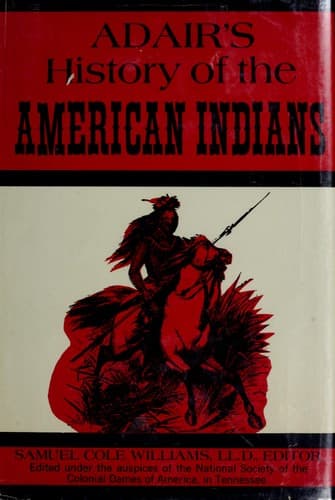
Adair's History of the American IndiansAdair, James
History
Adair's History of the American Indians
Adair, James
Indians -- Origin; Indians of North America -- Southern States
When I was on my way to the Chikkasah, at the Okchai, in the year 1745,
the conduct of the Muskohge Indians was exactly the same with regard to
a Cheerake stripling, whose father was a white man, and mother an
half-breed,—regardless of the pressing entreaties and very high offers
of the English traders, they burned him in their usual manner. This
seems to be copied from that law which expressly forbad the redeeming
any devoted persons, and ordered that they should be surely put to
death, Lev. xxvii. 29. This precept had evidently a reference to the law
of retaliation.—Saul in superstitious and angry mood, wanted to have
murdered or sacrificed to God his favourite son Jonathan, because when
he was fainting he tasted some honey which casually fell in his way,
just after he had performed a prodigy of martial feats in behalf of
Israel: but the gratitude, and reason of the people, prevented him from
perpetrating that horrid murder. If devoting to death was a divine
extraction, or if God delighted in human sacrifices, the people would
have been criminal for daring to oppose the divine law,—which was not
the case. Such a law if taken in an extensive and literal sense, is
contrary to all natural reason and religion, and consequently in a
strict sense, could not be enjoined by a benevolent and merciful God;
who commands us to do justice and shew mercy to the very beasts; not to
muzzle the ox while he is treading out the grain; nor to insnare the
bird when performing her parental offices. “Are ye not of more value
than many sparrows?”
The Indians use no stated ceremony in immolating their devoted captives,
although it is the same thing to the unfortunate victims, what form
their butcherers use. They are generally sacrificed before their
conquerors set off for war with their ark and supposed holy things. And
sometimes the Indians devote every one they meet in certain woods or
paths, to be killed there, except their own people; this occasioned the
cowardly Cheerake in the year 1753, to kill two white men on the
Chikkasah war-path, which leads from the country of the Muskohge. And
the Shawànoh Indians who {155} settled between the _Ooe-Asa_ and
_Koosah-towns_,[58] told us that their people to the northward had
devoted the English to death for the space of six years; but when that
time was expired and not before, they would live in friendship as
formerly. If the English had at that time executed their own law against
them, and demanded equal blood from the Cheeràke, and stopt all trade
with them before they dipt themselves too deep in blood, they would soon
have had a firm peace with all the Indian nations. This is the only way
of treating them now, for when they have not the fear of offending, they
will shed innocent blood, and proceed in the end to lay all restraint
aside.
Public-domain text, read in full here on John Shaqi.
Reviews
Reviews
No reviews yet
Be the first to share your thoughts on this work.
Elsewhere in the archive
Join the Discussion
Join the discussion
Sign in to leave a comment or review.
Sign InorCreate an account