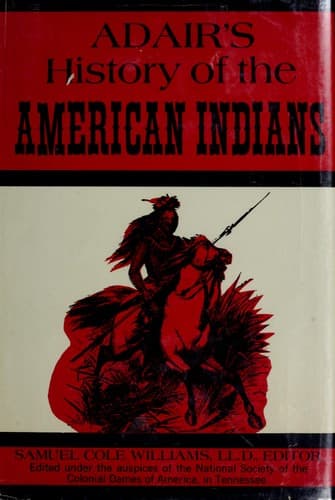
Adair's History of the American IndiansAdair, James
History
Adair's History of the American Indians
Adair, James
Indians -- Origin; Indians of North America -- Southern States
The late conduct of the Chikkasah war-council, in condemning two
pretended friends to death, who came with a view of shedding blood;
shews their knowledge of that equal law of divine appointment to the
Jews, “he shall be dealt with exactly as he intended to do to his
neighbour.”
It ought to be remarked, that they are careful of their youth, and fail
not to punish them when they transgress. Anno 1766, I saw an old head
man, called the _Dog-King_ (from the nature of his office) correct
several young persons—some for supposed faults, and others by way of
prevention. He began with a lusty young fellow, who was charged with
being more effeminate than became a warrior; and with acting contrary to
their old religious rites and customs, particularly, because he lived
nearer than any of the rest to an opulent and helpless German, by whom
they supposed he might have been corrupted. He bastinadoed the young
sinner severely, with a thick whip, about a foot and a half long,
composed of plaited silk grass, and the fibres of the button snake-root
stalks, tapering to the point, which was secured with a knot. He
reasoned with him, as he corrected him: he told him that he was
_Chehakse Kanèha-He_, literally, “you are as one who is wicked, and
almost lost[XXXIV].” The grey-hair’d corrector said, he treated him in
that manner according to ancient custom, through an effect of love, to
induce him to shun vice, and to imitate the virtues of {156} his
illustrious fore-fathers, which he endeavoured to enumerate largely:
when the young sinner had received his supposed due, he went off
seemingly well pleased.
Footnote XXXIV:
As _Chin-Kanehah_ signifies, “you have lost,” and _Che-Kanehah_, “you
are lost,” it seems to point at the method the Hebrews used in
correcting their criminals in Canaan, and to imply a similarity of
manners. The word they use to express “forgetfulness,” looks the very
same way, _Ish Al Kanehah_, “you forget,” meaning that _Ish_ and
_Canaan_ are forgotten by _Ale_.
This Indian correction lessens gradually in its severity, according to
the age of the pupils. While the _Dog-King_ was catechising the little
ones, he said _Che Haksianna_, “do not become vicious.” And when they
wept, he said _Che-Abela Awa_, “I shall not kill you,” or “I shall not
put you into the state of bleeding _Abéle_[XXXV].”
Footnote XXXV:
Public-domain text, read in full here on John Shaqi.
Reviews
Reviews
No reviews yet
Be the first to share your thoughts on this work.
Elsewhere in the archive
Join the Discussion
Join the discussion
Sign in to leave a comment or review.
Sign InorCreate an account