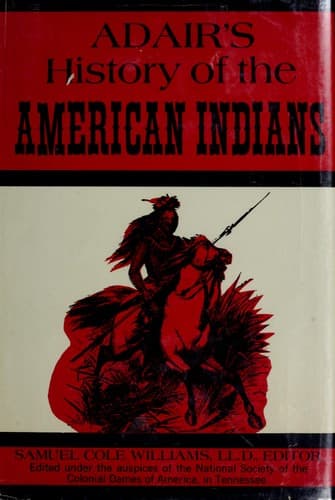
Adair's History of the American IndiansAdair, James
History
Adair's History of the American Indians
Adair, James
Indians -- Origin; Indians of North America -- Southern States
The Indian ark is deemed so sacred and dangerous to be touched, either
by their own sanctified warriors, or the spoiling enemy, that they durst
not touch it upon any account[XXXVII]. It is not to be meddled with by
any, except the war chieftain and his waiter, under the penalty of
incurring great evil. {162} Nor would the most inveterate enemy touch it
in the woods for the very same reason; which is agreeable to the
religious opinion and customs of the Hebrews, respecting the sacredness
of their ark, witness what befel Uzzah, for touching it, though with a
religious view, and the Philistines for carrying it away, so that they
soon thought proper to return it, with presents.
Footnote XXXVII:
A gentleman who was at the Ohio, in the year 1756, assured me he saw a
stranger there very importunate to view the inside of the Cheerake
ark, which was covered with a drest deer-skin, and placed on a couple
of short blocks. An Indian centinel watched it, armed with a hiccory
bow, and brass-pointed barbed arrows, and he was faithful to his
trust; for finding the stranger obtruding to pollute the supposed
sacred vehicle, he drew an arrow to the head, and would have shot him
through the body, had he not suddenly withdrawn; the interpreter, when
asked by the gentleman what it contained, told him there was nothing
in it but a bundle of conjuring traps. This shews what conjurers our
common interpreters are, and how much the learned world have really
profited by their informations. The Indians have an old tradition,
that when they left their own native land, they brought with them a
_sanctified rod_ by order of an oracle, which they fixed every night
in the ground; and were to remove from place to place on the continent
towards the sun-rising, till it budded in one night’s time; that they
obeyed the sacred mandate, and the miracle took place after they
arrived to this side of the Missisippi, on the present land they
possess. This, they say, was the sole cause of their settling here—of
fighting so firmly for their reputed holy land and holy things—and
that they may be buried with their beloved fore-fathers. I have seen
other Indians who pretend to the like miraculous direction, and I
think it plainly to refer to Aaron’s rod, which was a branch of an
almond-tree, and that budded and blossomed in one night. (A) The
Overhill Cherokees under Ostenaco (Outasite, another name) were on the
campaign of 1756, in aid of the British and American forces. Dinwiddie
Papers, II, 446 _et seq._ (W)
Public-domain text, read in full here on John Shaqi.
Reviews
Reviews
No reviews yet
Be the first to share your thoughts on this work.
Elsewhere in the archive
Join the Discussion
Join the discussion
Sign in to leave a comment or review.
Sign InorCreate an account