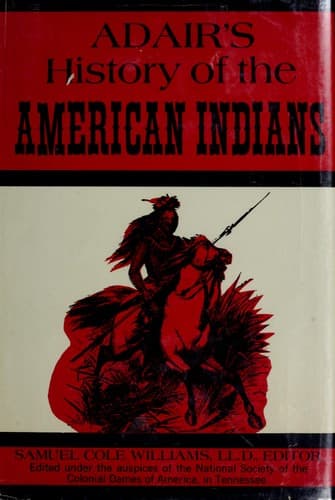
Adair's History of the American IndiansAdair, James
History
Adair's History of the American Indians
Adair, James
Indians -- Origin; Indians of North America -- Southern States
The leader virtually acts the part of a priest of war,[66] _pro
tempore_, in imitation of the Israelites fighting under the divine
military banner. If they obtain the victory, and get some of the enemies
scalps, they sanctify themselves when they make their triumphal
entrance, in the manner they observed before they set off to war; but,
if their expedition proves unfortunate, they only mourn over their loss,
ascribing it to the vicious conduct of some of the followers of the
beloved ark. What blushes should this savage virtue raise in the faces
of nominal christians, who ridicule the unerring divine wisdom, for the
effects of their own imprudent or vicious conduct. May they learn from
the rude uncivilized Americans, that vice necessarily brings evil—and
virtue, happiness.
The Indians will not cohabit with women while they are out at war;[67]
they religiously abstain from every kind of intercourse even with their
own wives, for the space of three days and nights before they go to war,
and so after they return home, because they are to sanctify themselves.
This religious war custom, especially in so savage a generation, seems
to be derived from the Hebrews, who thus sanctified themselves, to gain
the divine protection, and victory over their common enemies: as in the
precept of Moses to the war camp when he ascended Mount Sinai; and in
Joshua’s prohibition to the Israelites[XXXVIII]; and in the case of
Uriah. The warriors consider themselves as devoted to God apart from the
rest of the {163} people, while they are at war accompanying the sacred
ark with the supposed holy things it contains.
Footnote XXXVIII:
Joshua commanded the Israelites the night before they marched, to
sanctify themselves by washing their clothes, avoiding all impurities,
and abstaining from matrimonial intercourse.
The French Indians are said not to have deflowered any of our young
women they captivated, while at war with us;[68] and unless the black
tribe, the French Canadian priests, corrupted their traditions, they
would think such actions defiling, and what must bring fatal
consequences on their own heads. We have an attested narrative of an
English prisoner, who made his escape from the Shawanoh Indians, which
was printed at Philadelphia, anno 1757, by which we were assured, that
even that blood-thirsty villain, Capt. Jacob, did not attempt the virtue
of his female captives, lest (as he told one of them) it should offend
the Indian’s God; though at the same time his pleasures heightened in
proportion to the shrieks and groans of our people of different ages and
both sexes, while they were under his tortures.
Public-domain text, read in full here on John Shaqi.
Reviews
Reviews
No reviews yet
Be the first to share your thoughts on this work.
Elsewhere in the archive
Join the Discussion
Join the discussion
Sign in to leave a comment or review.
Sign InorCreate an account