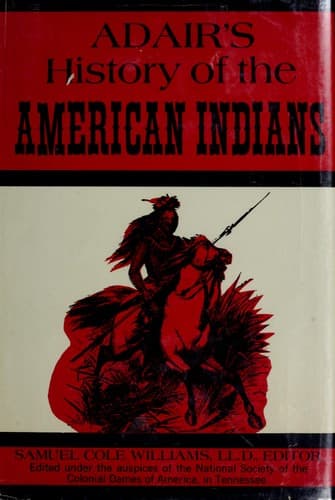
Adair's History of the American IndiansAdair, James
History
Adair's History of the American Indians
Adair, James
Indians -- Origin; Indians of North America -- Southern States
They imagined incense also to be a sure means to banish the devil;
though asafœtida, or the devil’s dung, might have been much better. On
Cant. iv. 6. “I will get me to the hill of incense,” the Chaldee
paraphrast says, that, while the house of Israel kept the art of their
holy fore-fathers, both the morning and mid-day evil spirits fled
away, because the divine glory dwelt in the sanctuary, which was built
on Mount Moriah; and that all the devils fled when they smelled the
effluvia of the fine incense that was there. They likewise believed
that herbs and roots had a power to expel dæmons. And Josephus tells
us, that the root _Bara_, immediately drives out the devil. I suppose
it had such a physical power against fevers and agues, as the jesuit’s
bark.
The church of Rome, in order to have powerful holy things, as well as
the Jews, applies salt, spittle, holy-water, and consecrated oil, to
expel the devils from the credulous of their own persuasion; and the
oil alone is used as a viaticum, on account of its lubricous quality,
to make them slippery, and thereby prevent the devil from laying hold,
and pulling them down when they ascend upward. They reckon that
observance a most religious duty, and an infallible preservative
against the legions of evil spirits who watch in the aerial regions;
and also necessary to gain celestial admission for believers.
In the Summer-season of the year 1746, I chanced to see the Indians
playing at a house of the former Missisippi-Nachee,[76] on one of their
old sacred musical instruments. It pretty much resembled the
Negroe-Banger in shape, but far exceeded it in dimensions; for it was
about five feet long, and a foot wide on the head-part of the board,
with eight strings made out of the sinews of a large buffalo. But they
were so unskilful in acting the part of the Lyrick, that the _Loache_,
or prophet who held the instrument between his feet, and along side of
his chin, took one end of the bow, whilst a lusty fellow held the other;
by sweating labour they scraped out such harsh jarring sounds, as might
have been reasonably expected by a soft ear, to have been sufficient to
drive out the devil if he lay any where hid in the house. When I
afterward asked him the name, and the reason of such a strange method of
diversion, he told me the dance was called _Keetla Ishto Hoollo_, “a
dance to, or before, the great holy one;” that it kept off evil spirit,
witches, and wizards, from the red people; and enabled them to ordain
elderly men to officiate in holy things, as the exigency of the times
required.
Public-domain text, read in full here on John Shaqi.
Reviews
Reviews
No reviews yet
Be the first to share your thoughts on this work.
Elsewhere in the archive
Join the Discussion
Join the discussion
Sign in to leave a comment or review.
Sign InorCreate an account