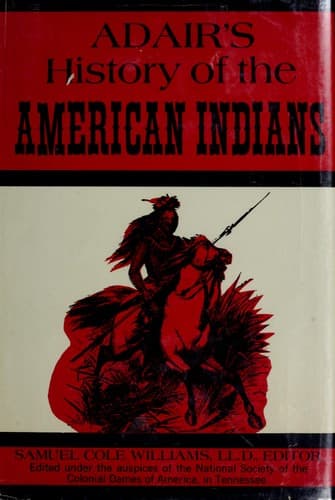
Adair's History of the American IndiansAdair, James
History
Adair's History of the American Indians
Adair, James
Indians -- Origin; Indians of North America -- Southern States
He who danced to it, kept his place and posture, in a very exact manner,
without the least perceivable variation: yet by the prodigious working
of his muscles and nerves, he in about half an hour, foamed in a very
extraordinary manner, and discontinued it proportionally, till he
recovered himself. This surprising custom I have mentioned here, because
it was usual among the Hebrews, for their prophets to become furious,
and as it were beside themselves, when they were about to prophesy. Thus
with regard to Saul, it seems that he became furious, and tortured his
body by violent gestures: and when Elisha sent one of the children of
the prophets to anoint Jehu, one said to him, wherefore cometh this mad
fellow? The Chaldee paraphrast, on 1 Sam. xviii. 10. concerning Saul’s
prophesying, paraphrases it, cæpit furire, “he began to grow mad, &c.”
When the East-Indian Fakirs are giving out their pretended prophecies,
they chuse drums and trumpets, that by such confused striking sounds,
{175} their senses may be lulled asleep or unsettled, which might
otherwise render them uncapable of receiving the supposed divine
inspiration. And they endeavour to become thus possest before crowds of
people with a furious rage, by many frantic and violent motions of body,
and changes of posture, till they have raised it to the highest pitch
they are capable of, and then fall on the ground almost breathless; when
they recover themselves a little, they give out their prophecies, which
are deemed oracular.
Lactantius and others tell us, that the Sibyls were possest of the like
fury; and most part of the ancients believed they ought to become
furious, the members of the body to shake, and the hairs of their head
to stand an end before they could be divinely inspired: which seems
plainly to shew, that though the ancient heathens mimicked a great deal
of the Mosaic law, yet theirs had but a faint glance on the Hebrew
manner of consulting Yohewah; whereas the Indian Americans invoke the
true God, by his favourite essential name, in a bowing posture, on every
material occasion, whether civil, martial, or religious, contrary to the
usage of all the old heathen world.
Public-domain text, read in full here on John Shaqi.
Reviews
Reviews
No reviews yet
Be the first to share your thoughts on this work.
Elsewhere in the archive
Join the Discussion
Join the discussion
Sign in to leave a comment or review.
Sign InorCreate an account