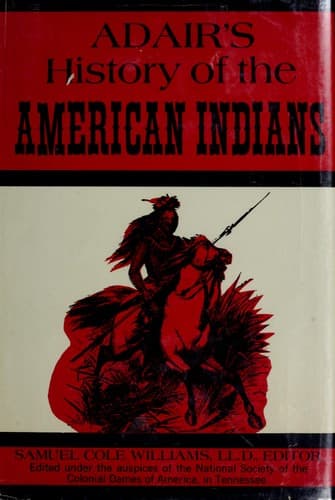
Adair's History of the American IndiansAdair, James
History
Adair's History of the American Indians
Adair, James
Indians -- Origin; Indians of North America -- Southern States
This account was taken in the Tuccabatchey-square, 27th July, 1759,
per _Will. Bolsover_. (A) It was at this town, the great Shawnee
leader, Tecumseh, delivered orations against the Americans and their
government which led the Upper Creeks to rise in arms (1813), and
finally to the Creek War. The same plates are referred to in C. Swan’s
Account in Schoolcraft’s _Information Indian Tribes_, V, 283. (W)
As the Hebrews carefully buried their dead, so on any accident, they
gathered their bones and laid them in the tombs of their
fore-fathers:[78] Thus, all the numerous nations of Indians perform the
like friendly office to every deceased person of their respective tribe;
insomuch, that those who {179} lose their people at war, if they have
not corrupted their primitive customs, are so observant of this kindred
duty, as to appropriate some time to collect the bones of their
relations; which they call _bone gathering_, or “gathering the bones to
their kindred,” according to the Hebrew idiom[XLVI]. The Cheerake, by
reason of their great intercourse with foreigners, have dropped that
friendly office: and as they seem to be more intelligent than the rest
of our English-American Indians in their religious rites, and ceremonial
observances, so I believe, the fear of pollution has likewise
contributed to obliterate that ancient kindred duty. However, they
separate those of their people who die at home, from others of a
different nation; and every particular tribe indeed of each nation bears
an intense love to itself, and divides every one of its people from the
rest, both while living, and after they are dead.
Footnote XLVI:
With the Hebrews, “to gather,” usually signified to die. Gen. xlix.
33. Jacob is said to be gathered to his people. Psal. xxvi. 9. Gather
not my soul with sinners. And Numb. xx. 24. Aaron shall be gathered to
his people.
When any of them die at a distance, if the company be not driven and
pursued by the enemy, they place the corpse on a scaffold,[79] covered
with notched logs to secure it from being torn by wild beasts, or fowls
of prey: when they imagine the flesh is consumed, and the bones are
thoroughly dried, they return to the place, bring them home, and inter
them in a very solemn manner. They will not associate with us, when we
are burying any of our people, who die in their land: and they are
unwilling we should join with them while they are performing this
kindred duty to theirs. Upon which account, though I have lived among
them in the raging time of the small pox, even of the confluent sort, I
never saw but one buried, who was a great favourite of the English, and
chieftain of _Ooeasa_, as formerly described.
Public-domain text, read in full here on John Shaqi.
Reviews
Reviews
No reviews yet
Be the first to share your thoughts on this work.
Elsewhere in the archive
Join the Discussion
Join the discussion
Sign in to leave a comment or review.
Sign InorCreate an account