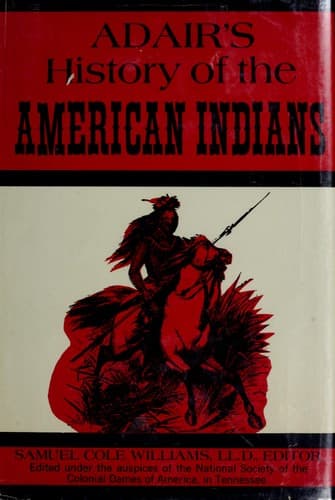
Adair's History of the American IndiansAdair, James
History
Adair's History of the American Indians
Adair, James
Indians -- Origin; Indians of North America -- Southern States
The Indians use the same ceremonies to the bones of their dead, as if
they were covered with their former skin, flesh, and ligaments. It is
but a few days since I saw some return with the bones of nine of their
people, who had been two months before killed by the enemy. They were
tied in white deer-skins, separately; and when carried by the door of
one of the houses of their family, they were laid down opposite to it,
till the female {180} relations convened, with flowing hair, and wept
over them about half an hour. Then they carried them home to their
friendly magazines of mortality, wept over them again, and then buried
them with the usual solemnities; putting their valuable effects, and as
I am informed, other convenient things in along with them, to be of
service to them in the next state. The chieftain carried twelve short
sticks tied together, in the form of a quadrangle; so that each square
consisted of three. The sticks were only peeled, without any paintings;
but there were swans feathers tied to each corner, and as they called
that frame, _Tereekpe tobeh_, “a white circle,” and placed it over the
door, while the women were weeping over the bones, perhaps it was
originally designed to represent the holy fire, light, and spirit, who
formerly presided over the four principal standards of the twelve tribes
of Israel.
When any of their people die at home, they wash and anoint the corpse,
and soon bring it out of doors for fear of pollution; then they place it
opposite to the door, on the skins of wild beasts, in a sitting posture,
as looking into the door of the winter house, westward, sufficiently
supported with all his moveable goods; after a short elogium, and space
of mourning, they carry him three times around the house in which he is
to be interred, stopping half a minute each time, at the place where
they began the circle, while the religious man of the deceased person’s
family, who goes before the hearse, says each time, _Yàh_, short with a
bass voice, and then invokes on a tenor key, _Yo_, which at the same
time is likewise sung by all the procession, as long as one breath
allows. Again, he strikes up, on a sharp treble key, the fœminine note,
_He_, which in like manner, is taken up and continued by the rest: then
all of them suddenly strike off the solemn chorus, and sacred
invocation, by saying, on a low key, _Wàh_; which constitute the divine
essential name, _Yohewah_. This is the method in which they performed
the funeral rites of the chieftain before referred to; during which
time, a great many of the traders were present, as our company was
agreeable at the interment of our declared patron and friend. It seems
as if they buried him in the name of the divine essence, and directed
their plaintive religious notes to the author of life and death, in
hopes of a resurrection of the body; which hope engaged the Hebrews to
stile their burying places, “the house of the living.” {181}
Public-domain text, read in full here on John Shaqi.
Reviews
Reviews
No reviews yet
Be the first to share your thoughts on this work.
Elsewhere in the archive
Join the Discussion
Join the discussion
Sign in to leave a comment or review.
Sign InorCreate an account