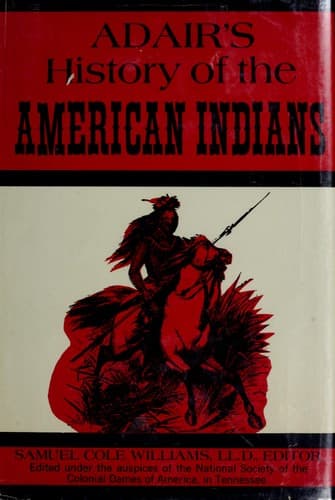
Adair's History of the American IndiansAdair, James
History
Adair's History of the American Indians
Adair, James
Indians -- Origin; Indians of North America -- Southern States
When they celebrated these funeral rites of the above chieftain, they
laid the corpse in his tomb, in a sitting posture, with his face towards
the east, his head anointed with bear’s oil, and his face painted red,
but not streaked with black, because that is a constant emblem of war
and death; he was drest in his finest apparel, having his gun and pouch,
and trusty hiccory bow, with a young panther’s skin, full of arrows,
along side of him, and every other useful thing he had been possessed
of,—that when he rises again, they may serve him in that tract of land
which pleased him best before he went to take his long sleep. His tomb
was firm and clean in-side. They covered it with thick logs, so as to
bear several tiers of cypress-bark, and such a quantity of clay as would
confine the putrid smell, and be on a level with the rest of the floor.
They often sleep over those tombs; which, with the loud wailing of the
women at the dusk of the evening, and dawn of the day, on benches close
by the tombs, must awake the memory of their relations very often: and
if they were killed by an enemy, it helps to irritate and set on such
revengeful tempers to retaliate blood for blood.
The Egyptians either embalmed, or buried, their dead: other heathen
nations imagined that fire purified the body; they burned therefore the
bodies of their dead, and put their ashes into small urns, which they
religiously kept by them, as sacred relicks. The Tartars called
_Kyrgessi_, near the frozen sea, formerly used to hang their dead
relations and friends upon trees, to be eaten by ravenous birds to
purify them. But the Americans seem evidently to have derived their copy
from the Israelites, as to the place where they bury their dead, and the
method of their funeral ceremonies, as well as the persons with whom
they are buried, and the great expenses they are at in their burials.
The Hebrews buried near the city of Jerusalem, by the brook Kedron; and
they frequently hewed their tombs out of rocks, or buried their dead
opposite to their doors, implying a silent lesson of friendship, and a
pointing caution to live well. They buried all of one family together;
to which custom David alludes, when he says, “gather me not with the
wicked:” and Sophronius said with regard to the like form, “noli me
tangere, hæretice, neque vivum nec mortuum.” But they buried strangers
apart by themselves, and named the place, _Kebhare Galeya_, “the burying
place of strangers.” And these rude Americans are so strongly partial to
the same custom, that they imagine if any of us {182} were buried in the
domestic tombs of their kindred, without being adopted, it would be very
criminal in them to allow it; and that our spirits would haunt the eaves
of their houses at night, and cause several misfortunes to their family.
Public-domain text, read in full here on John Shaqi.
Reviews
Reviews
No reviews yet
Be the first to share your thoughts on this work.
Elsewhere in the archive
Join the Discussion
Join the discussion
Sign in to leave a comment or review.
Sign InorCreate an account