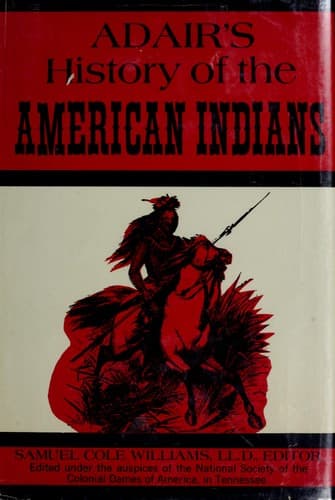
Adair's History of the American IndiansAdair, James
History
Adair's History of the American Indians
Adair, James
Indians -- Origin; Indians of North America -- Southern States
Their law compels the widow, through the long term of her weeds, to
refrain all public company and diversions, at the penalty of an
adulteress; {186} and likewise to go with flowing hair, without the
privilege of oil to anoint it. The nearest kinsmen of the deceased
husband, keep a very watchful eye over her conduct, in this respect. The
place of interment is also calculated to wake the widow’s grief, for he
is intombed in the house under her bed. And if he was a war-leader, she
is obliged for the first moon, to sit in the day-time under his mourning
war-pole[XLIX], which is decked with all his martial trophies, and must
be heard to cry with bewailing notes. But none of them are fond of that
month’s supposed religious duty, it chills, or sweats, and wastes them
so exceedingly; for they are allowed no shade, or shelter. This sharp
rigid custom excites the women to honour the marriage-state, and keeps
them obliging to their husbands, by anticipating the visible sharp
difficulties which they must undergo for so great a loss. The three or
four years monastic life, which she lives after his death, makes it her
interest to strive by every means, to keep in his lamp of life, be it
ever so dull and worthless; if she is able to shed tears on such an
occasion, they often proceed from self-love. We can generally
distinguish between the widow’s natural mourning voice, and her tuneful
laboured strain. She doth not so much bewail his death, as her own
recluse life, and hateful state of celibacy; which to many of them, is
an uneligible, as it was to the Hebrew ladies, who preferred death
before the unmarried state, and reckoned their virginity a bewailable
condition, like the state of the dead.
Footnote XLIX:
The war-pole is a small peeled tree painted red, the top and boughs
cut off short: it is fixt in the ground opposite to his door, and all
his implements of war, are hung on the short boughs of it, till they
rot.
The Choktah Indians hire mourners to magnify the merit and loss of their
dead, and if their tears cannot be seen to flow, their shrill voices
will be heard to cry, which answers the solemn chorus a great deal
better[L]. However, they are no way churlish of their tears, for I have
seen them, on the occasion, pour them out, like fountains of water: but
after having {187} thus tired themselves, they might with equal
propriety have asked by-standers in the manner of the native Irish, Ara
ci fuar bass—“And who is dead?”
Footnote L:
Jer. ix. 17. 19. Thus saith the Lord of hosts: consider ye, and call
for the mourning-women, that they may come; and send for cunning
women, that they may come. For a voice of wailing is heard out of
Zion, how are we spoiled? we are greatly confounded, because we have
forsaken the land, because our dwellings have cast us out.
Public-domain text, read in full here on John Shaqi.
Reviews
Reviews
No reviews yet
Be the first to share your thoughts on this work.
Elsewhere in the archive
Join the Discussion
Join the discussion
Sign in to leave a comment or review.
Sign InorCreate an account