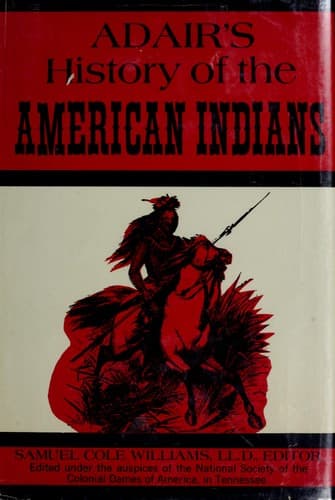
Adair's History of the American IndiansAdair, James
History
Adair's History of the American Indians
Adair, James
Indians -- Origin; Indians of North America -- Southern States
They formerly dressed their heads with black moss on those solemn
occasions; and the ground adjacent to the place of interment, they now
beat with laurel-brushes, the women having their hair disheveled: the
first of which customs seems to be derived from the Hebrew custom of
wearing sack-cloth at their funeral solemnities, and on other occasions,
when they afflicted their souls before God—to which divine writ often
alludes, in describing the blackness of the skies: and the laurel being
an ever-green, is a lively emblem of the eternity of the human soul, and
the pleasant state it enters into after death, according to antiquity.
They beat it on the ground, to express their sharp pungent grief; and,
perhaps, to imitate the Hebrew trumpeters for the dead, in order to make
as striking a sound as they possibly can on so doleful an occasion.
Though the Hebrews had no positive precept that obliged the widow to
mourn the death of her husband, or to continue her widowhood, for any
time; yet the gravity of their tempers, and their scrupulous nicety of
the law of purity, introduced the observance of those modest and
religious customs, as firmly under the penalty of shame, as if they bore
the sanction of law[LI]. In imitation of them, the Indians have copied
so exactly, as to compel the widow to act the part of the disconsolate
dove, for the irreparable loss of her mate. Very different is the custom
of other nations:—the Africans, when any of their head-men die, kill all
their slaves, their friends that were dearest to them, and all their
wives whom they loved best, that they may accompany and serve them, in
the other world, which is a most diabolical Ammonitish sacrifice of
human blood. The East-India widows may refuse to be burned on their
husbands funeral piles, with impunity, if they become prostitutes, or
public women to sing and dance at marriages, or on other occasions of
rejoicing. How superior {188} is the virtuous custom of the savage
Americans, concerning female chastity during the time of their
widowhood?
Footnote LI:
Theodosius tells us, Lib. I. Legum de fecundis nuptiis, that women
were infamous by the civil law, who married a second time before a
year, or at least ten months were expired.
Public-domain text, read in full here on John Shaqi.
Reviews
Reviews
No reviews yet
Be the first to share your thoughts on this work.
Elsewhere in the archive
Join the Discussion
Join the discussion
Sign in to leave a comment or review.
Sign InorCreate an account