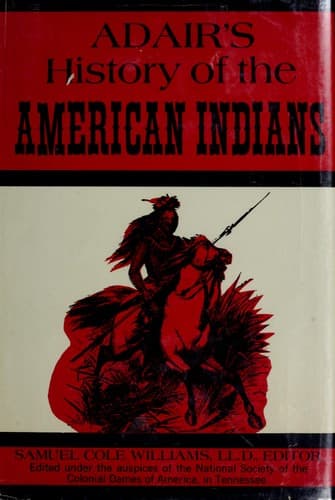
Adair's History of the American IndiansAdair, James
History
Adair's History of the American Indians
Adair, James
Indians -- Origin; Indians of North America -- Southern States
Acosta tells us, that the Peruvians held a very extraordinary feast
called _Ytu_,—which they prepared themselves for, by fasting two days,
not accompanying with their wives, nor eating salt-meat or garlic, nor
drinking Chica during that period—that they assembled all together in
one place, and did not allow any stranger or beast to approach them;
that they had clothes and {202} ornaments which they wore, only at that
great festival; that they went silently and sedately in procession, with
their heads veil’d, and drums beating—and thus continued one day and
night; but the next day they danced and feasted; and for two days
successively, their prayers and praises were heard. This is another
strong picture of the rites of the Indian North-Americans, during the
time of their great festival, to atone for sin; and with a little
amendment, would exhibit a surprising analogy of sundry essential rites
and customs of the Northern and South American Indians, which equally
glance at the Mosaic system.
Lerius tells us, that he was present at the triennial feast of the
Caribbians, where a multitude of men, women, and children, were
assembled; that they soon divided themselves into three orders, apart
from each other, the women and children being strictly ordered to stay
within, and to attend diligently to the singing: that the men sung in
one house, _He, He, He_, while the others in their separate houses,
answered by a repetition of the same notes: that having thus continued a
quarter of an hour, they all danced in three different rings, each with
rattles, &c. And the natives of Sir Francis Drake’s New Albion, were
desirous of crowning him _Hio_, or _Ohio_, a name well known in North
America, and hath an evident relation to the great beloved name. Had the
former been endued with a proper capacity, and given a suitable
attention to the Indian general law of purity, he would probably have
described them singing _Yo He Wah, Hallelu-Yah_, &c. after the present
manner of our North American red natives; and as giving proper names to
persons and things from a religious principle, to express the relation
they bore to the sacred four-lettered name.
These writers report also, that the Mexicans sacrificed to the idol
_Haloc_, “their God of water,” to give them seasonable rains for their
crops: and they tell us, that the high-priest was anointed with holy
oil, and dressed with pontifical ornaments, peculiar to himself, when he
officiated in his sacred function; that he was sworn to maintain their
religion, rights, and liberties, according to their ancient law; and to
cause the sun to shine, and all their vegetables to be properly
refreshed with gentle showers. If we throw down the “monkish idol god of
water,” we here find a strong parity of religious customs and
ceremonies, between the pretended prophets, and high-priests of the
present northern Indians, and the ancient Mexicans. {203}
Public-domain text, read in full here on John Shaqi.
Reviews
Reviews
No reviews yet
Be the first to share your thoughts on this work.
Elsewhere in the archive
Join the Discussion
Join the discussion
Sign in to leave a comment or review.
Sign InorCreate an account