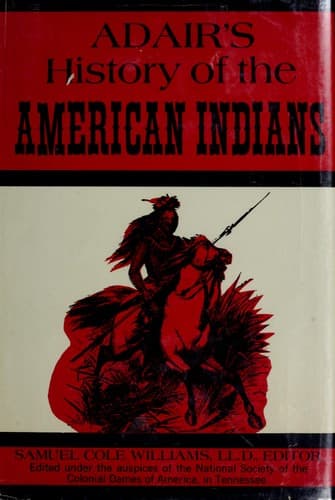
Adair's History of the American IndiansAdair, James
History
Adair's History of the American Indians
Adair, James
Indians -- Origin; Indians of North America -- Southern States
Acosta tells us, that the Peruvians acknowledged a supreme God, and
author of all things, whom they called _Viracocha_, and worshipped as
the chief of all the gods, and honoured when they looked at the heavens
or any of the celestial orbs; that for want of a proper name for that
divine spirit of the universe, they, after the Mexican manner,[92]
described him by his attributes,—as _Pachacamac_, “the Creator of heaven
and earth.” But, though he hath described them possessed of these strong
ideas of God, and to have dedicated a sacred house to the great first
cause, bearing his divine prolific name; yet the Spanish priesthood have
at the same time, painted them as worshipping the devil in the very same
temple. Here and there a truth may be found in their writings, but if we
except the well-designed performance of Don Antonio de Ulloa, one
duodecimo volume would have contained all the accounts of any curious
importance, which the Spaniards have exhibited to the learned world,
concerning the genuine rites and customs, of the ancient Peruvians and
Mexicans, ever since the seisure of those countries, and the horrid
murders committed on the inhabitants.
But among all the Spanish friars, _Hieronimo Roman_ was the greatest
champion in hyperbolical writing. He has produced three volumes
concerning the Indian American rites and ceremonies;—he stretches very
far in his second part of the commonwealths of the world; but when he
gets to Peru and Mexico, the distance of those remote regions enables
him to exceed himself: beyond all dispute, the other writers of his
black fraternity, are only younger brethren, when compared to him in the
marvellous. His, is the chief of all the Spanish romances of Peru and
Mexico.[93]
He says, the Indian natives, from Florida to Panama, had little religion
or policy; and yet he affirms a few pages after, that they believed in
one true, immortal and invisible God, reigning in heaven, called
_Yocahuuagnamaorocoti_; and is so kind as to allow them images, priests,
and popes, their high-priest being called _papa_ in that language. The
origin of images among them, is accounted for in a dialogue he gives us,
between a shaking tree and one of the Indian priests: after a great deal
of discourse, the tree ordered the priest to cut it down, and taught him
how to make images thereof, and erect a temple. The tree was obeyed, and
every year their votaries solemnized the dedication. The good man has
{204} laboured very hard for the images, and ought to have suitable
applause for so useful an invention; as it shews the universal opinion
of mankind, concerning idols and images. With regard to that long
conjectural divine name, by which they expressed the one true God, there
is not the least room to doubt, that the South-Americans had the divine
name, _Yohewah_, in as great purity as those of the north, especially,
as they were at the fountain head; adding to it occasionally some other
strong compound words.
Public-domain text, read in full here on John Shaqi.
Reviews
Reviews
No reviews yet
Be the first to share your thoughts on this work.
Elsewhere in the archive
Join the Discussion
Join the discussion
Sign in to leave a comment or review.
Sign InorCreate an account