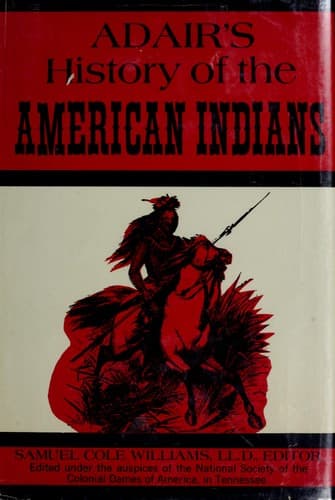
Adair's History of the American IndiansAdair, James
History
Adair's History of the American Indians
Adair, James
Indians -- Origin; Indians of North America -- Southern States
He says also, that the metropolis of Cholola had as many temples as
there were days in the year; and that one of them was the most famous in
the world, the basis of the spire being as broad as a man could shoot
with a cross bow, and the spire itself three miles high. The temples
which the holy man speaks of, seem to have been only the dwelling-houses
of strangers, who incorporated with the natives, differing a little in
their form of structure, according to the usual custom of our northern
Indians: and his religious principles not allowing him to go near the
reputed shambles of the devil, much less to enter the supposed
territories of hell, he has done pretty well by them, in allowing them
golden suns and moons—vestry keepers, &c. The badness of his optic
instruments, if joined with the supposed dimness of his sight, may plead
in excuse for the spiral altitude, which he fixes at 15,480 feet; for
from what we know of the northern Indians, we ought to strike off the
three first figures of its height, and the remaining 40 is very likely
to have been the just height of the spire, alias the red-painted, great,
_war-pole_.
The same writer tells us, that the Peruvian pontifical office belonged
to the eldest son of the king, or some chief lord of the country: and
that it devolved by succession. But he anoints him after a very solemn
manner, with an ointment which he carefully mixes with the blood of
circumcised infants. This priest of war dealing so much in blood
himself, without doubt, suspected them of the like; though at the same
time no Indian priest will either shed, or touch human blood: but that
they formerly circumcised, may with great probability be allowed to the
holy man.
The temples of Peru were built on high grounds, or tops of hills, he
says, and were surrounded with four circular mounds of earth, the one
rising {205} gradually above the other, from the outermost circle; and
that the temple stood in the center of the inclosed ground, built in a
quadrangular form, having altars, &c. He has officiously obtruded the
sun into it; perhaps, because he thought it dark within. He describes
another religious house, on the eastern part of that great inclosure,
facing the rising sun, to which they ascended by six steps, where, in
the hollow of a thick wall, lay the image of the sun, &c. This thick
wall having an hollow part within it, was no other than their sanctum
sanctorum, conformably to what I observed, concerning the pretended
holiest place of the Muskohge Indians. Any one who is well acquainted
with the language, rites, and customs of the North-American Indians, can
see with a glance when these monkish writers stumble on a truth, or
ramble at large.
Public-domain text, read in full here on John Shaqi.
Reviews
Reviews
No reviews yet
Be the first to share your thoughts on this work.
Elsewhere in the archive
Join the Discussion
Join the discussion
Sign in to leave a comment or review.
Sign InorCreate an account