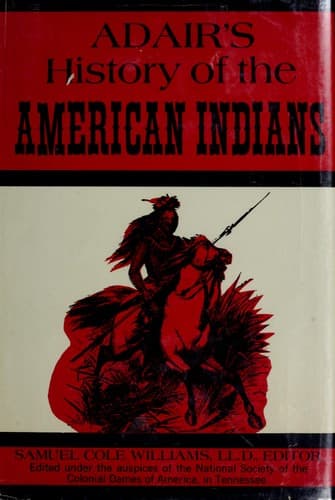
Adair's History of the American IndiansAdair, James
History
Adair's History of the American Indians
Adair, James
Indians -- Origin; Indians of North America -- Southern States
Ribault Laudon describing the yearly festival of the Floridans, says,
that the day before it began, the women sweeped out a great circuit of
ground, where it was observed with solemnity;—that when the main body of
the people entered the holy ground, they all placed themselves in good
order, stood up painted, and decked in their best apparel, when three
_Iawas_, or priests, with different paintings and gestures followed
them, playing on musical instruments, and singing with a solemn
voice—the others answering them: that when they made three circles in
this manner, the men ran off to the woods, and the women staid weeping
behind, cutting their arms with muscle-shells, and throwing the blood
towards the sun; and that when the men returned, the three days feast
was finished. This is another confused Spanish draught of the Floridan
passover, or feast of love; and of their universal method of bleeding
themselves after much exercise, which according to the Spanish plan,
they offered up to the sun. From these different writers, it is plain
that where the Indians have not been corrupted by foreigners, their
customs and religious worship are nearly alike; and also that every
different tribe, or nation of Indians, uses such-like divine proper
name, and awful sounds, as _Yah-Wah_, _Hetovah_, &c. being
transpositions of the divine essential name, as our northern Indians
often repeat in their religious dances. As the sound of _Yah-wah_ jarred
in Laudon’s ear, he called it _Java_, in resemblance to the Syriac and
Greek method of expressing the tetra-grammaton, from which Galatinus
imposed it upon us, calling it _Jehowah_, instead of _Yohewah_. {208}
The Spanish writers tell us, that the Mexicans had a feast, and month,
which they called _Hueitozolti_, when the maiz was ripe; every man at
that time bringing an handful to be offered at the temple, with a kind
of drink, called _Utuli_, made out of the same grain.—But they soon deck
up an idol with roses, garlands, and flowers, and describe them as
offering to it sweet gums, &c. Then they speedily dress a woman with the
apparel of either the god, or goddess, of salt, which must be to season
the human sacrifices, as they depicture them according to their own
dispositions. But they soon change the scene, and bring in the god of
gain, in a rich temple dedicated to him, where the merchants apart
sacrifice vast numbers of purchased captives. It often chagrines an
inquisitive and impartial reader to trace the contradictions, and
chimerical inventions, of those aspiring bigoted writers; who speak of
what they did not understand, only by signs, and a few chance words. The
discerning reader can easily perceive them from what hath been already
said, and must know that this Spanish mountain in labour, is only the
Indian first fruit-offering, according to the usage of our
North-American Indians.
Public-domain text, read in full here on John Shaqi.
Reviews
Reviews
No reviews yet
Be the first to share your thoughts on this work.
Elsewhere in the archive
Join the Discussion
Join the discussion
Sign in to leave a comment or review.
Sign InorCreate an account