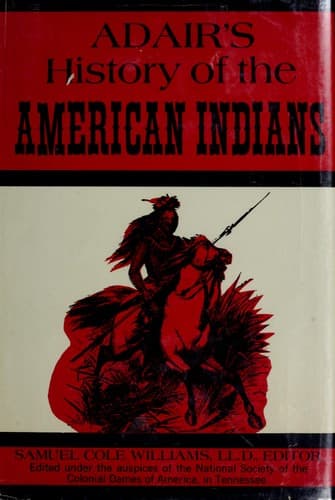
Adair's History of the American IndiansAdair, James
History
Adair's History of the American Indians
Adair, James
Indians -- Origin; Indians of North America -- Southern States
As their western, or upper towns, which are situated among the
Apalahche-mountains, on the eastern branches of the Missisippi, were
always engaged in hot war with the more northern Indians; and the middle
and lower towns in constant hostility with the Muskohge, till reconciled
by a governor of South-Carolina for the sake of trade,—several of their
best towns, on the southern branch of Savanah-river, are now forsaken
and destroyed: as _Ishtatohe_, _Echia_, _Toogalo_, &c., and they are
brought into a narrower compass. At the conclusion of our last war with
them,[115] the traders calculated the number of their warriors to
consist of about two thousand three-hundred, which is a great diminution
for so short a space of time: and if we may conjecture for futurity,
from the circumstances already past, there will be few of them alive,
after the like revolution of time. Their towns are still scattered wide
of each other, because the land will not admit any other settlement: it
is a rare thing to see a level tract of four hundred acres. They are
also strongly attached to rivers,—all retaining the opinion of the
ancients, that rivers are necessary to constitute a paradise. Nor is it
only ornamental, but likewise beneficial to them, on account of
purifying themselves, and also for the services of common life,—such as
fishing, {227} fowling, and killing of deer, which come in the warm
season, to eat the saltish moss and grass, which grow on the rocks, and
under the surface of the waters. Their rivers are generally very
shallow, and pleasant to the eye; for the land being high, the waters
have a quick descent; they seldom overflow their banks, unless when a
heavy rain falls on a deep snow.—Then, it is frightful to see the huge
pieces of ice, mixed with a prodigious torrent of water, rolling down
the high mountains, and over the steep craggy rocks, so impetuous, that
nothing can resist their force. Two old traders saw an instance of this
kind, which swept away great plantations of oaks and pines, that had
their foundation as in the center of the earth.—It overset several of
the higher rocks, where the huge rafts of trees and ice had stopped up
the main channel, and forced itself across through the smaller hills.
Public-domain text, read in full here on John Shaqi.
Reviews
Reviews
No reviews yet
Be the first to share your thoughts on this work.
Elsewhere in the archive
Join the Discussion
Join the discussion
Sign in to leave a comment or review.
Sign InorCreate an account